
A compliance article states, with complete confidence, that the EU Packaging and Packaging Waste Regulation contains recyclability grades running from A through E. It gives thresholds, a deadline and a short list of recommended actions for packaging teams. The formatting is clean, the tone is assured, and the page carries a recent publication date. The claim is also false. The final Regulation recognises three grades, not five, and the two that are missing were not quietly dropped by an editor. They were removed during the legislative process itself, and their absence is the point.
This is not an isolated curiosity. It is representative of a pattern now appearing across search results, comparison sites and internally circulated briefings wherever companies try to understand Regulation (EU) 2025/40, commonly known as the PPWR. The pattern deserves more attention than the amusement it sometimes provokes, because the packaging decisions built on it are not amusing at all.
Why the false version looks credible
The recyclability-grades example is worth pausing on because nothing about it looks careless. It reads like the work of someone who understands packaging regulation, because in a narrow sense it draws on material that once genuinely existed. Grades A through E did appear at an earlier stage of the PPWR’s development. The problem is not that the information is invented from nothing. It is invented from the wrong moment in time, presented as though that moment were the present one.
This is what makes synthetic regulatory misinformation harder to manage than ordinary error. An obviously wrong statement invites scrutiny. A statement that is fluent, well-structured and partially grounded in something real invites acceptance instead. The reader has no easy way to distinguish a claim checked against the final Official Journal text from one generated by pattern-completion, whether by a person working too quickly from secondary sources or by a language model asked to summarise “the PPWR” without being told which version of it.
Defining the problem precisely
The term AI slop was coined for low-effort synthetic content produced at scale and optimised for engagement rather than accuracy. Applied to regulatory compliance, it captures something real but risks understating the mechanism, because what circulates about the PPWR is rarely sloppy in any visible sense. It is often the opposite: confident, structured and superficially professional. A more precise description is synthetic regulatory misinformation, meaning content that reproduces the surface features of authoritative analysis, tone, structure, specificity, apparent recency, while severing the link to the text that would actually make it authoritative.
That severing happens through several distinct mechanisms, and the distinction matters because each calls for a different response. An obsolete draft can simply remain online after the law moves past it. A negotiated amendment can be mistaken for adopted text by a writer who stopped following the file before the trilogue concluded. Automated summarisation can blend language from the 2022 Commission proposal with a date drawn from the 2025 Official Journal text, producing a hybrid that never existed in any single document. A search engine can reward whichever page answers a question most simply, not whichever answers it correctly. A consultant under time pressure can repeat a secondary source without opening the operative text. A generative system can complete a plausible regulatory sentence with a number that fits the pattern without corresponding to any figure the Regulation contains. A website can update its publication date while leaving the substantive claim beneath it untouched. None of this requires an intention to deceive. All of it produces the same outcome: a claim that looks current and is wrong.
Why the PPWR is unusually exposed
Some legislation is simple enough that this kind of drift rarely matters. The PPWR is not, and the reason is structural.
The Regulation reached its final form through five materially different stages: the European Commission’s original proposal, COM(2022) 677; the separate negotiating positions developed by the European Parliament and the Council; a provisional political agreement, summarised in press coverage before the legal text was finalised; formal adoption on 19 December 2024, published in the Official Journal on 22 January 2025 and entering into force on 11 February 2025, with a general date of application of 12 August 2026; and a further layer still incomplete, since a substantial number of technical details, calculation methodologies, harmonised label formats, the precise thresholds within each recyclability grade, are left to delegated and implementing acts the Commission must adopt over the following years.
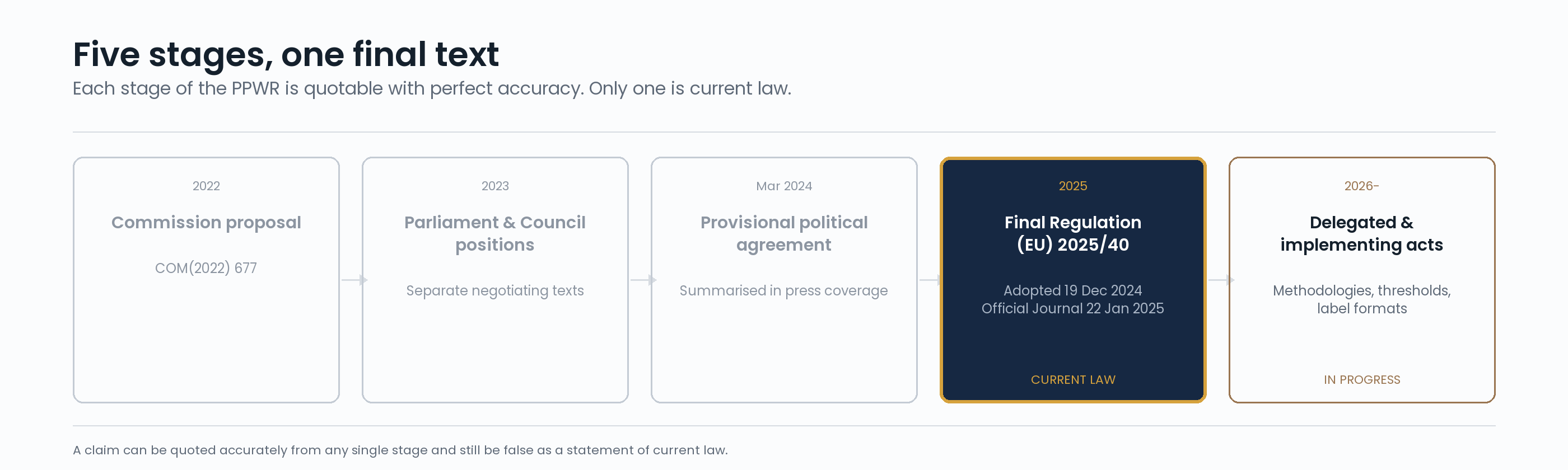
Each stage produced text that can be quoted with perfect accuracy. Only the fourth is current law.
Five layers of material, each internally coherent and each quotable with perfect accuracy in isolation. When a writer does not track which layer a given claim comes from, the result is not fabrication so much as collapse. A figure that was true in 2022 sits beside a date fixed only in 2025. A provision that was proposed and later abandoned sits beside one that survived intact into the final text. The language describing both is identical: declarative, confident, dated as though current.
Draft contamination: the recyclability grades
The final PPWR, under Article 6 and the detail set out in Annex II, establishes three recyclability performance grades. Grade A requires at least 95 per cent recyclability by weight, Grade B at least 80 per cent, and Grade C at least 70 per cent. Packaging below the Grade C threshold is treated as not recyclable and, from 1 January 2030, may not be placed on the EU market in that condition. From 1 January 2038 the bar rises again: Grade C is no longer sufficient, and packaging must reach Grade A or B to remain compliant. Grades D and E belonged to an earlier structure considered during the legislative process and were not carried into the final text.
This is the clearest available instance of a draft fossil: a provision from an earlier proposal that survives online, sometimes for years, after the body that wrote it has moved on. Draft fossils are dangerous not because they are exotic but because they are so easy to produce innocently. A comparison table built in 2023, when the five-grade structure was still under discussion, does not correct itself when the law changes. Left unattended, it simply continues circulating as though it were current.
Hybrid law: the empty-space ratio
A subtler pattern combines elements from different points in time into a claim that never corresponded to any single legal text. Some circulating commentary states that the PPWR caps packaging empty space at 40 per cent from August 2026. Both figures need correcting, though not for the same reason. The final Regulation, under Article 18, sets a maximum empty space ratio of 50 per cent for specified grouped, transport and e-commerce packaging, excluding reusable packaging from the calculation. The 40 per cent figure circulated during an earlier stage of the process and appears to have persisted in some commentary after the threshold changed. The August 2026 date is a separate error: the obligation takes effect not on the Regulation’s general application date but from 1 January 2030, with the Commission required to adopt an implementing act on the calculation methodology by 12 February 2028.
Call this hybrid law: a genuinely earlier number combined with a genuinely real, but misapplied, date, producing a rule precise-sounding enough to be defensible while corresponding to nothing any institution enacted. Each half of the claim traces to something real. Only a reader checking the operative Article against the actual figure and the actual date would notice they come from different legislative moments.
A taxonomy of regulatory misinformation
A consistent set of patterns recurs across the wider body of PPWR commentary, and naming them precisely is more useful than treating each as an isolated mistake.
Wrong addressee errors occur when an obligation aimed at one actor is silently reassigned to another. Article 43 requires Member States to reduce per-capita packaging waste by at least 5 per cent by 2030, 10 per cent by 2035 and 15 per cent by 2040, against a 2018 baseline. Some summaries convert this into an instruction that every manufacturer must cut the weight of every package by the same percentages. The figures survive the transcription; the legal claim does not, since the obligation sits with national governments managing aggregate waste, not with individual companies.
Scope laundering occurs when limiting words quietly disappear, turning a narrow rule into an apparent general prohibition. The PFAS restriction is the clearest case. Article 5 does not ban PFAS outright. It applies concentration thresholds, 25 parts per billion for any individual substance, 250 parts per billion for the sum of targeted substances, 50 parts per million for total PFAS including polymeric forms, specifically to food-contact packaging, from 12 August 2026. “Total ban” travels well in marketing copy; it is a materially different claim from a threshold-based, scope-specific restriction. The same laundering merges distinct mechanisms elsewhere. Article 12 requires harmonised, pictogram-based material-composition labelling across nearly all packaging from no earlier than 12 August 2028; a separate provision requires only reusable packaging to carry a QR code or comparable digital carrier tracking trips and rotations, from 12 February 2029. Neither is the Digital Product Passport created under separate EU legislation. “QR codes on every package” collapses three requirements into one.
Recycled-content and compostability claims show the same scope error applied to materials and formats. The mandatory recycled-content targets under Article 10 apply to the plastic components of packaging and vary by category; they do not extend to metal or glass. Compostability under Article 9 is mandatory, from 12 February 2028, only for sticky fruit and vegetable labels, permeable tea and coffee bags, and comparable soft single-serve units, while non-permeable formats such as many coffee capsules remain a Member State option tied to local biowaste infrastructure, not a Union-wide mandate. Each case mistakes a reasonable sustainability aspiration for a legal requirement wider than the text supports.
The reuse targets under Article 29 show how one word can carry a sentence’s legal weight. The Regulation sets binding minimum percentages for reusable packaging in specified sectors from 2030, then sets higher 2040 percentages that operators must endeavour to achieve rather than are bound to meet. Replace “endeavour to achieve” with “must achieve,” and a policy direction reads as an enforceable quota, though the number itself was stated correctly.
Registration architecture illustrates the same pattern with direct commercial stakes. Some commentary describes a single EU-wide register replacing national systems. Article 44 requires each Member State to maintain its own producer register, and Article 45 makes registration in every Member State of first market access a condition of selling there from 12 August 2026. The rules are harmonised; the registers are not, and a strategy built around a single filing risks an inadequate structure across the markets a company actually serves.
Finally, date flattening is the pattern most likely to distort planning even when every other detail is correct. Twelve August 2026 genuinely governs the PFAS restriction and baseline registration. It does not govern the empty-space ratio (2030), the recyclability grades (2030 and 2038), the compostability mandate (2028) or the reusable-packaging labelling requirement (2029). A calendar built around one memorable date will be wrong for most of what it purports to track. Underlying several of these dates sits a related pattern, implementation-act blindness: presenting a requirement as settled when its operative detail still depends on a delegated or implementing act not yet adopted.
Fluency is not authority
None of this is best understood as an accuracy problem solved by more careful proofreading. It reflects something structural about how generative systems and search-optimised content interact with regulated information.
A well-formed sentence about a legal obligation and a well-formed sentence describing an actual legal obligation are, at the level of grammar and tone, indistinguishable. Generative language models produce the former with great skill. They are not, by design, verifying the latter against a specific, dated, authoritative text unless explicitly directed to do so and given the means. The result carries every stylistic marker of legal expertise, structured clauses, precise percentages, confident modal verbs, while the evidentiary chain connecting it to Regulation (EU) 2025/40 has quietly disappeared. Readers who associate fluency with expertise, a reasonable heuristic in most everyday contexts, are given no signal that anything is missing.
Repetition compounds the problem. Once an inaccurate PPWR claim is published, it becomes a plausible source for the next summary, the next comparison site, and potentially the next generative system trained on a corpus that includes it. A claim repeated across a dozen independently written pages can come to feel like consensus, even where each traces back to the same original error rather than to twelve independent checks against the Official Journal.
What is lost in the process is legislative history itself, understood not as trivia but as the record of what was proposed, contested and abandoned before a text became binding. A regulation is not simply the sentences that survive. It is the outcome of negotiation among institutions with different priorities, and the discarded alternatives, the five-grade recyclability system, the 40 per cent empty-space threshold, remain permanently discoverable online precisely because nothing distinguishes a superseded draft from operative law unless someone says so.
The cost of false certainty
Companies that maintain rigorous chain-of-custody records for raw materials and supplier audits frequently apply far less discipline to the information used to design the compliance programmes governing those same materials. That asymmetry is worth correcting, because the downstream costs are concrete rather than abstract.
Premature packaging redesign against a threshold never adopted wastes engineering time and tooling investment. Data-system procurement to track a QR-code obligation that does not apply to the format in question wastes budget a correctly scoped programme would not have required. Supplier specifications drafted around the wrong recycled-content scope create contracts that do not match legal reality. Risk assessments built on a flattened calendar misallocate regulatory-affairs attention toward dates that are not yet binding, while genuinely binding ones receive too little preparation. Customer communications repeating an inaccurate total ban, or a fictional single EU register, create statements a company may later need to retract. The risk runs both ways: under-compliance from a misread scope is the more obvious danger, but over-compliance, redesigning packaging or committing publicly to obligations that do not exist in the form assumed, carries its own cost once the discrepancy surfaces.
Corporate responsibility in the age of generative AI
None of this argues against using generative tools in regulatory work. Used well, they accelerate research, surface relevant provisions and organise legislative material faster than a person working alone. The relevant question for a company is not whether artificial intelligence was involved in producing a piece of compliance guidance, a question close to unanswerable in practice given how embedded these tools now are in everyday drafting. The question that matters is whether the resulting claim is traceable to the current, adopted text, correctly scoped to the packaging format and addressee it concerns, and reviewed by someone competent to tell a genuine obligation from its plausible-sounding cousin.
Legal information used to design a compliance programme is, in this sense, a controlled input no different in principle from a material specification or a supplier certificate. It deserves the same discipline: a documented source, a version reference, and a named person accountable for having checked it against the operative text rather than against a summary of a summary.
A verification framework for PPWR claims
A useful discipline, applicable to any PPWR-related claim before it informs a decision, is to require a clear answer to each of the following.
Eight questions before a PPWR claim is treated as reliable
- What exact Article, paragraph or Annex supports the claim, traceable in the text as published in the Official Journal.
- Is the source describing the final Regulation or an earlier proposal, negotiating position or provisional agreement.
- Who is the legal addressee: a Member State, an economic operator, a producer, or another actor entirely.
- What material, packaging format and use case does the provision actually cover, and does the claim match that scope precisely.
- What exemptions or derogations apply.
- Is the application date fixed in the Regulation itself, or dependent on a delegated or implementing act not yet adopted.
- Has the interpretation been checked against the European Commission’s own Guidance and FAQ material, bearing in mind that this guidance is explicitly interpretive and does not amend the Regulation.
- Is the claim presented as settled when the underlying methodology, a calculation rule, a label design, an assessment criterion, remains genuinely incomplete.
This is not a fact-checking exercise performed once and filed away. It is an information-governance discipline, comparable in seriousness to the version control a company already applies to contracts and technical drawings, and it belongs in the same category of control.
Provenance as part of the control environment
The most persuasive piece of misinformation about the PPWR is unlikely to be the one that is obviously wrong. Grades running to E, an outright PFAS ban, a single EU register: each is checkable in minutes once a reader knows to look. The greater risk sits in the claim that is almost entirely correct, professionally written and internally consistent, wrong in exactly one respect that happens to be decisive, the scope, the addressee, the date, the threshold, or whether the obligation carries legal force at all rather than the character of a target a company is merely expected to endeavour toward. Such errors are harder to catch precisely because everything around them is accurate, which is exactly what makes them capable of shaping a genuinely wrong decision.
Regulation (EU) 2025/40 will continue to be implemented in stages for several years, through delegated acts, implementing acts and evolving Commission guidance, which means the information environment around it will keep changing even as the underlying legal text becomes more settled. Treating a regulatory claim as reliable because it is fluent, confident and widely repeated is no longer a safe default. Provenance, the ability to trace a compliance claim back to a specific Article in a specific, dated, adopted text, is not a peripheral concern for a legal department. It belongs inside the control environment itself, alongside the other records a company already keeps to demonstrate that its decisions were made on the basis of something real.
References
- Regulation (EU) 2025/40 of the European Parliament and of the Council of 19 December 2024 on packaging and packaging waste. Official Journal, 22 January 2025. EUR-Lex.
- European Commission, Proposal for a Regulation on packaging and packaging waste, COM(2022) 677 final, 30 November 2022. EUR-Lex, CELEX:52022PC0677.
- European Commission, FAQ on the Packaging and Packaging Waste Regulation (PPWR), published 30 March 2026, updated 1 August 2026.
- European Commission, Guidance document on the Packaging and Packaging Waste Regulation (PPWR).
This article provides regulatory analysis and commentary based on Regulation (EU) 2025/40, its legislative history and publicly available European Commission guidance. It does not constitute legal advice. Companies should confirm current obligations against the operative legal text and, where appropriate, qualified legal counsel, before making compliance decisions. Regulatory information, including Commission guidance and pending delegated and implementing acts, may be updated after publication of this article.