
Every powered device both emits electromagnetic energy and is vulnerable to it. Keeping those emissions from interfering with everything nearby is a legal requirement, not a design preference, and it is normally solved with metal. Paper is an unlikely candidate, yet it has become one of the more interesting substrates in shielding research. The reason has less to do with blocking signals than with what happens to the energy afterwards.
Why shielding is needed at all
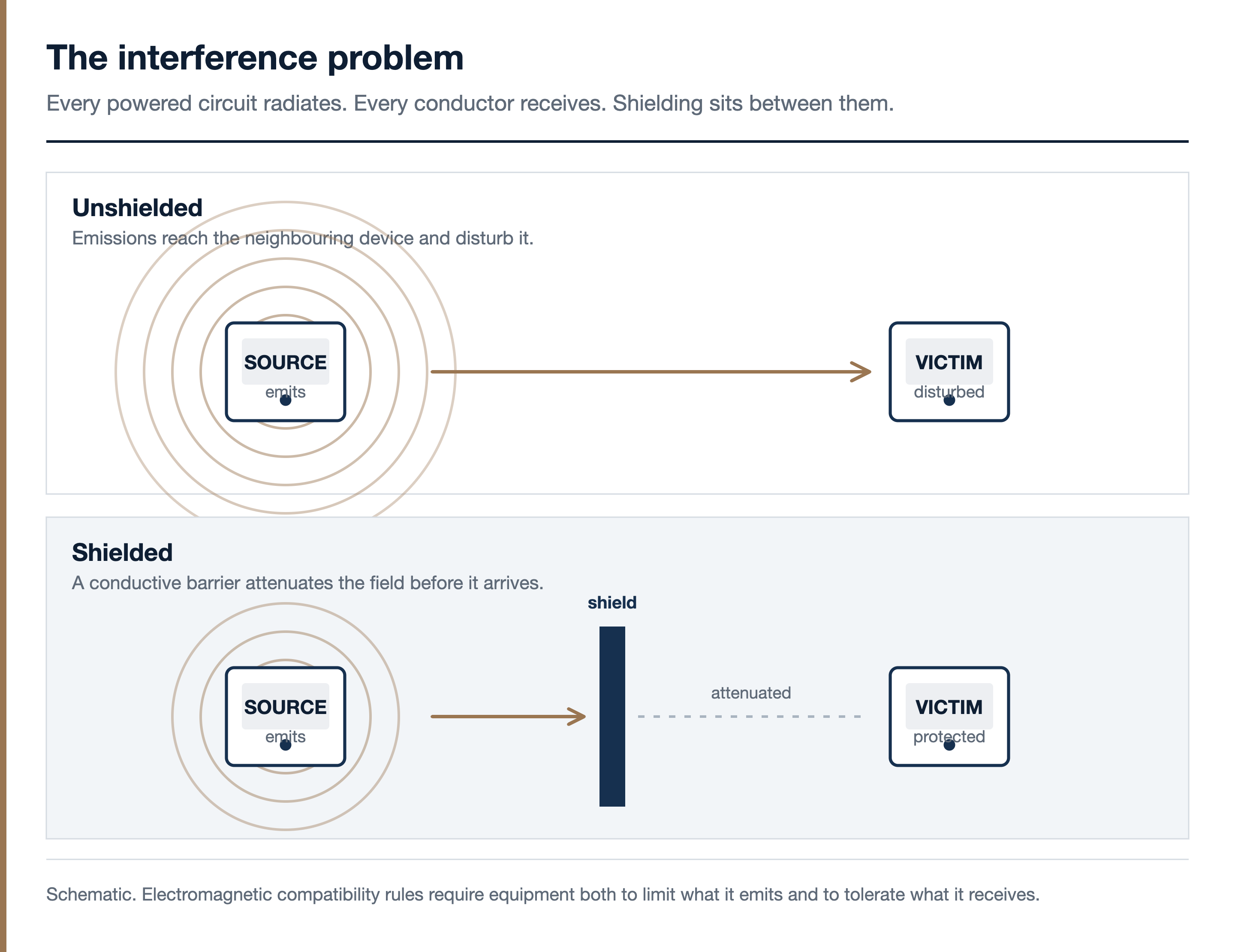
Any circuit carrying a changing current radiates an electromagnetic field. Any conductor sitting in a changing field has a current induced in it. Those two facts, taken together, are the whole problem: electronic devices broadcast unintentionally, and they listen unintentionally.
The consequence is electromagnetic interference: unwanted energy from one device disturbing the operation of another. In consumer equipment this shows up as degraded wireless performance or audible noise. In medical, automotive, avionic and industrial control systems, the consequences are more serious, which is why electromagnetic compatibility is regulated. Equipment placed on the EU market must meet limits on what it emits and demonstrate immunity to what it receives.
The pressure has increased for straightforward reasons. Devices are denser, so more emitters sit closer together. Operating frequencies have risen. Wireless connectivity is now standard in products that previously had none. And enclosures have moved from metal to plastic, removing shielding that used to come free with the housing.
How shielding is normally done
The conventional answer is a conductive barrier: a metal enclosure, a metallised film, a sprayed conductive coating, or a metal-filled composite. Placed between a source and its surroundings, it prevents the field from passing.
Metal works well and is well understood. Its drawbacks are equally familiar: weight, corrosion, cost, limited formability, and (for thin films and coatings) poor durability under flexing. Those constraints are what motivate the search for alternatives, particularly anywhere weight, flexibility or conformability matters.
Which brings us to an apparently unpromising material.
Paper, on its own, does nothing
Shielding requires interaction between the electromagnetic wave and mobile electric charge. Metals shield because their free electrons respond to the incoming field. Cellulose has no free electrons: neat cellulose paper has an electrical conductivity in the order of 10⁻¹¹ S/cm, which is to say it is an insulator by any standard.
So paper alone cannot shield, and no amount of thickness will change that. Every functioning system therefore introduces a conductive phase (silver nanowires, MXene, carbon nanotubes or graphene) into or onto the fibre network. The effect is dramatic: a single dip-coating cycle with silver nanowires took cellulose paper to 0.34 S/cm in the in-plane direction, an increase of some ten orders of magnitude.
That raises the obvious question. If the conductive filler is doing the shielding, why involve paper at all? Why not simply use metal foil? Answering that requires a distinction which total shielding figures conceal.
Blocking is not the same as removing
Shielding performance is quoted in decibels, describing how much of an incident wave fails to pass through the barrier. Around 20 dB (roughly 99 per cent attenuation) is the conventional threshold for commercial adequacy. But total effectiveness conceals a distinction that matters enormously in practice, because a wave can be stopped in two quite different ways.
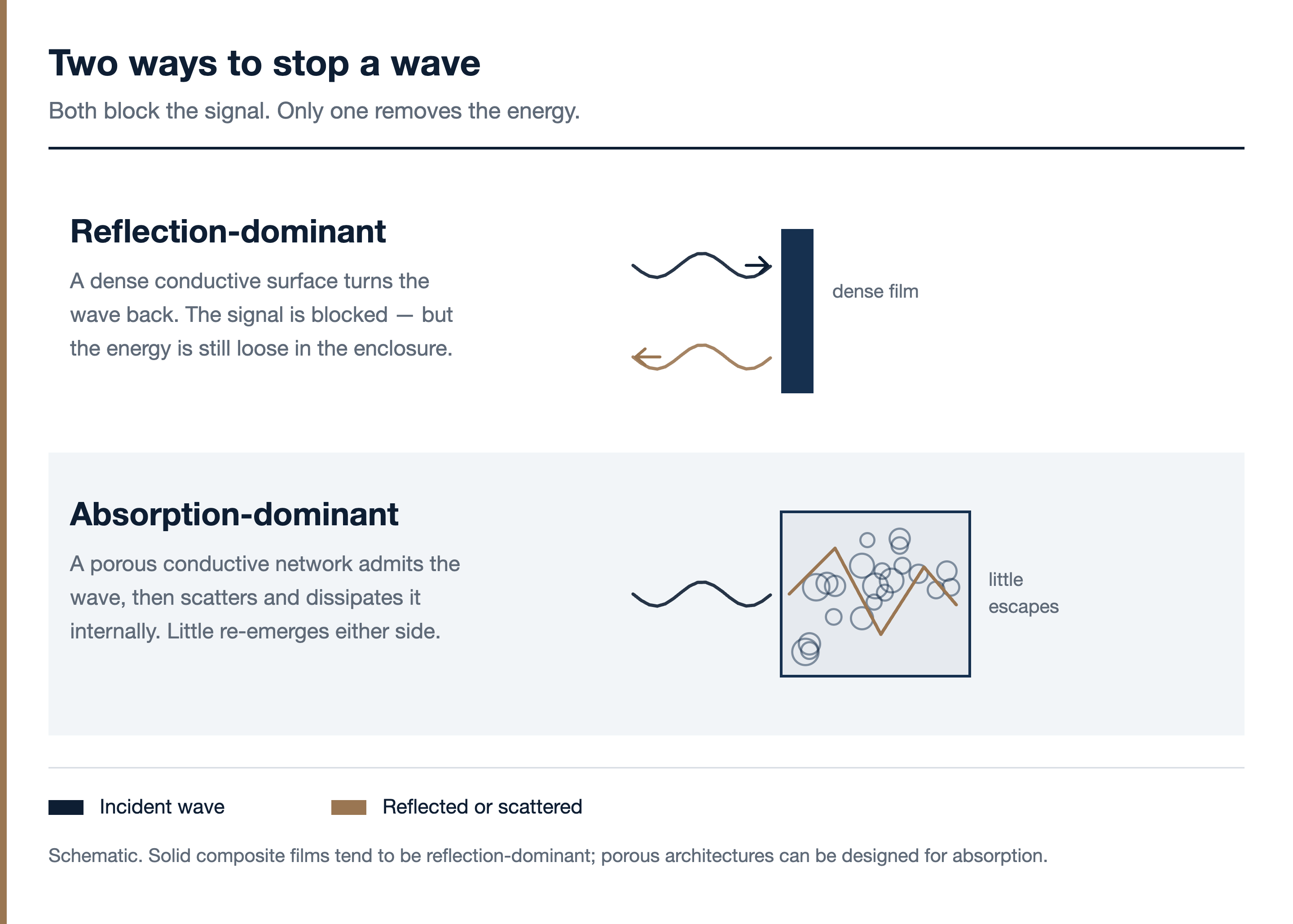
Reflection turns the wave around at the surface. The receiver behind the shield is protected, but the energy has not gone anywhere. In a dense electronic assembly it is now bouncing around inside the enclosure, available to interfere with something else.
Absorption admits the wave and dissipates its energy inside the material, ultimately as a small amount of heat. Nothing is sent back.
Why structure decides which one you get
The literature is consistent on the governing rule: solid composite films exhibit a reflection-dominant shielding mechanism, while porous materials and complex microstructures can be designed for enhanced absorption.
The reason is impedance. A dense, highly conductive surface presents a large mismatch to free space, and a large mismatch reflects. A porous network is a gentler transition: the wave enters, and once inside a maze of conductive surfaces it is scattered repeatedly, losing energy at each encounter. Multiple internal reflections turn a single pass into a long path.
This is precisely where a cellulose fibre network earns its place. It is not the shielding agent. It is a lightweight, porous, mechanically coherent scaffold that positions the conductive phase in three dimensions, and porosity is the variable that converts a reflector into an absorber.
How lopsided the split can be
In cellulose nanofibre/PVA/MXene cryogels, shielding by absorption reached 49.2 dB while shielding by reflection remained at 2.3 dB at 20 GHz. Almost all the attenuation came from energy dissipated inside the material rather than turned back at its face. A porous MXene/cellulose composite with a deliberate conductivity gradient achieved 31.2 dB across the X band with an absorption coefficient of 0.84.
What the numbers look like
With that distinction in place, the reported performance figures become easier to read. Values vary widely with architecture, and the spread is instructive.
Carbon nanotube/cellulose aerogels, high in porosity and low in density, reached 18.7–22.5 dB. Silver nanowires assembled on both faces of cellulose paper with a hydrophobic ceramic gave 46 dB against the X band at a silver loading of only 0.13 mg/cm², with multiple reflections between the two conductive surfaces doing much of the work. Cellulose nanofibre papers combining MXene and silver nanowires reached 43.65 dB, though with a reflection-dominant mechanism. Sandwich films of cellulose nanocrystals, silver nanowires and MXene reached 90 dB.
Two things are worth reading out of that spread. First, cellulose-based systems comfortably exceed the commercial threshold. Second, the highest total figures come from dense, highly conductive constructions, which are also the most reflective. Total shielding effectiveness and absorption dominance pull in opposite directions.
Designing the gradient
The more sophisticated designs resolve that tension by refusing to be uniform. A layer of moderate conductivity at the entry face matches impedance and lets the wave in; a highly conductive layer at the rear stops anything reaching the far side. The wave is admitted, attenuated, and then prevented from leaving: a sequence described in one study as low reflection, absorption, reflection and reabsorption.
Some designs add magnetic loss to electrical loss, placing a magnetic–conductive hybrid at the front as an impedance-matching layer and silver nanowires behind it as the shielding layer. Others exploit the fact that in cryogels the surface skin dominates behaviour: the structural design of a porous hybrid can be used to tune performance across GHz and THz frequencies.
The honest position
Cellulose contributes structure, not shielding. What it offers is low density, mechanical integrity, flexibility, formability into porous architectures, and a renewable substrate. The shielding itself comes from silver, MXene or carbon: materials that are neither cheap nor, in the case of silver, abundant. Describing these as “sustainable” shields requires care about which component is doing the work.
So: can paper block EMI?
Native paper cannot. Paper, functionalised with a conductive network can, at levels well beyond commercial requirements, and the fibre network makes possible a form of shielding that a metal foil cannot easily provide, because foil reflects almost everything it stops.
The interest is not that cellulose is a shielding material. It is that a porous fibre scaffold is a good way to hold a small quantity of conductive material in a geometry that dissipates energy rather than redirecting it. That is a structural argument, and it is the same one that runs through fibre-based materials generally: the fibre network is rarely the functional component, but it is very often what makes the functional component work.
References
- Controlling the cell and surface architecture of cellulose nanofiber/PVA/Ti₃C₂Tₓ MXene hybrid cryogels for optimized permittivity and EMI shielding performance. Materials & Design. ScienceDirect
- Porous MXene/cellulose composite with gradient conductivity for electromagnetic interference shielding and enhanced absorption. Cellulose. Springer
- Highly effective electromagnetic interference shielding materials based on silver nanowire/cellulose papers. ACS Applied Materials & Interfaces. ACS
- Highly bendable and durable waterproof paper for ultra-high electromagnetic interference shielding. PMC
- Flexible sandwich-shaped cellulose nanocrystals/silver nanowires/MXene films exhibit efficient EMI shielding performance. PMC
Related reading
This article reflects independent professional analysis and is provided for informational purposes. Shielding values are frequency- and thickness-dependent and specific to the constructions reported in the cited studies. Last reviewed July 2026.