
Lignin is the substance that allows a tree to stand up. It is the second most abundant biopolymer on Earth, the largest renewable source of aromatic carbon, and the single greatest obstacle to using plant biomass. Understanding why all three statements are true requires understanding one unusual fact about how it is built.
A polymer without a template
Most biological macromolecules are made to a specification. Proteins are assembled from a genetic template, residue by residue. Cellulose is a regular, repeating chain of glucose units. Lignin is not made this way.
Lignin is formed by oxidative radical coupling. Precursor alcohols are exported into the cell wall, oxidised by enzymes such as peroxidases and laccases into phenolic radicals, and those radicals then couple with one another and with the growing polymer wherever chemistry permits. The sequence of monomers and the pattern of bonds are not specified anywhere in the genome. They are the statistical outcome of a combinatorial process.
The core point
Lignin has no defined primary structure. Two molecules of lignin from the same tree are almost certainly different from one another. Everything else that is interesting about lignin (its strength, its resistance to decay, its variability between species, and the difficulty of converting it into defined chemicals) follows from this single structural fact.
What it is made of
The polymer is built principally from three hydroxycinnamyl alcohols, the monolignols: p-coumaryl alcohol, coniferyl alcohol and sinapyl alcohol. Incorporated into the polymer these become the p-hydroxyphenyl (H), guaiacyl (G) and syringyl (S) units. They differ only in the number of methoxy groups on the aromatic ring: none, one and two respectively.
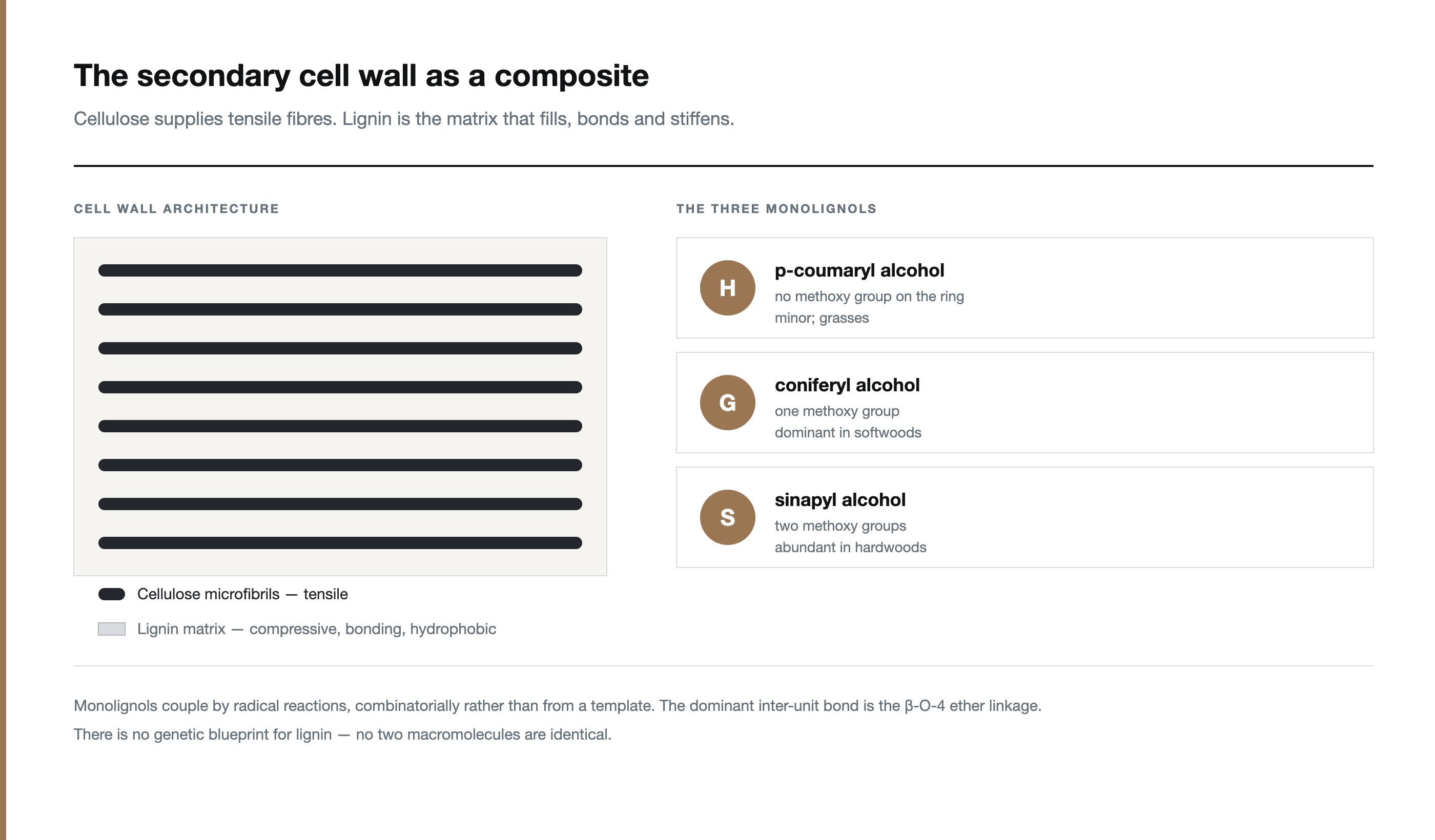
That small difference has large consequences. A methoxy group occupies a ring position that would otherwise be available for carbon–carbon bonding. Softwood lignins, dominated by G units, can crosslink extensively and are correspondingly more condensed and recalcitrant. Hardwood lignins contain substantial S units, whose additional methoxy group blocks a coupling site, giving a more linear, more ether-rich polymer. Grasses incorporate all three unit types along with other phenolic components.
The bonds between units fall into two families: ether linkages and carbon–carbon linkages. The dominant one is the β-O-4 aryl ether, reported at roughly 35–60 per cent of linkages in softwood and 50–80 per cent in hardwood. This matters practically as well as structurally: the β-O-4 bond is comparatively cleavable, and it is the principal target of nearly every strategy for breaking lignin down into useful molecules. The carbon–carbon linkages (5-5, β-5, β-β and others) are far more resistant, and their proportion largely determines how stubborn a given lignin will be.
The glue analogy, and its limits
Describing lignin as the glue that holds a tree together is a reasonable first approximation, but the more accurate description is that lignin is the matrix phase of a natural fibre composite. The secondary cell wall consists of cellulose microfibrils, which are extremely strong in tension, embedded in a matrix of lignin and hemicellulose. The role is closely analogous to resin in a glass-fibre laminate.
Cellulose alone would give a plant tensile strength but little resistance to buckling. Lignin supplies compressive rigidity, transfers load between fibres, and bonds adjacent cells together at the middle lamella. It also renders the wall hydrophobic, which is what makes the xylem capable of conducting water under tension without collapsing, and it presents a formidable chemical barrier to microbial and enzymatic attack.
These functions are not incidental. Lignification is what permitted plants to grow tall on land, to move water from root to canopy, and to resist decay. The polymer is a structural and hydraulic solution, arrived at by evolution, to the problem of living upright in air.
Abundance
Lignin is generally described as the second most abundant biopolymer on the planet after cellulose, and it has been estimated to account for something in the order of 30 per cent of organic carbon in the biosphere. In wood it typically represents a substantial minority of dry mass, with the proportion and composition varying by species, tissue and growth conditions.
It is also produced industrially at very large scale, as the principal by-product of chemical pulping. The great majority of that technical lignin is burned in the recovery boiler for process energy and chemical recovery. Only a small proportion is isolated for material or chemical use, lignosulfonates from sulfite pulping being the longest-established example.
Why so little is valorised
The obstacle is structural irregularity, compounded by processing. A refinery converting crude oil works with defined molecules and predictable reactions. Lignin arrives as a heterogeneous, partially condensed material whose structure has already been altered by the pulping process that liberated it. Depolymerisation yields a mixture of aromatics rather than a single product, and separating that mixture economically remains the central difficulty. This is the reasoning behind “lignin-first” biorefining, which seeks to extract lignin under conditions that preserve the cleavable β-O-4 linkages rather than destroying them.
Why this matters beyond the tree
Lignin is the only large-scale renewable source of aromatic carbon. Practically every aromatic chemical in current industrial use is derived from petroleum. If aromatic chemistry is to be defossilised, lignin is the feedstock with potential, and the same recalcitrance that makes it excellent structural material makes that conversion difficult.
The same property governs paper packaging. How much lignin remains in a pulp, and in what condition, determines strength, brightness, ageing behaviour and how the fibre performs on repeated recycling. Mechanical pulps retain most of their lignin and yellow on exposure to light; chemical pulps remove most of it at a cost in yield. These are not incidental process details but direct consequences of the polymer’s chemistry.
References
- Barros, J., Serrani-Yarce, J. C., et al. Lignin biosynthesis: old roads revisited and new roads explored. Open Biology, Royal Society. Royal Society
- Molecular structural dataset of lignin macromolecule elucidating experimental structural compositions. Scientific Data, Nature. Nature
- A Review: Depolymerization of Lignin to Generate High-Value Bio-Products. Frontiers in Energy Research. Frontiers
- Glasser, W. G. About Making Lignin Great Again — Some Lessons From the Past. Frontiers in Chemistry. Frontiers
- Liu, C.-J., Miao, Y.-C., Zhang, K.-W. Sequestration and Transport of Lignin Monomeric Precursors. Molecules, 16(1), 710.
Related reading
This article reflects independent professional analysis and is provided for informational purposes. Figures for linkage proportions and lignin content vary with species, tissue and analytical method; readers requiring precise values should consult the primary literature for the specific material in question. Last reviewed July 2026.