
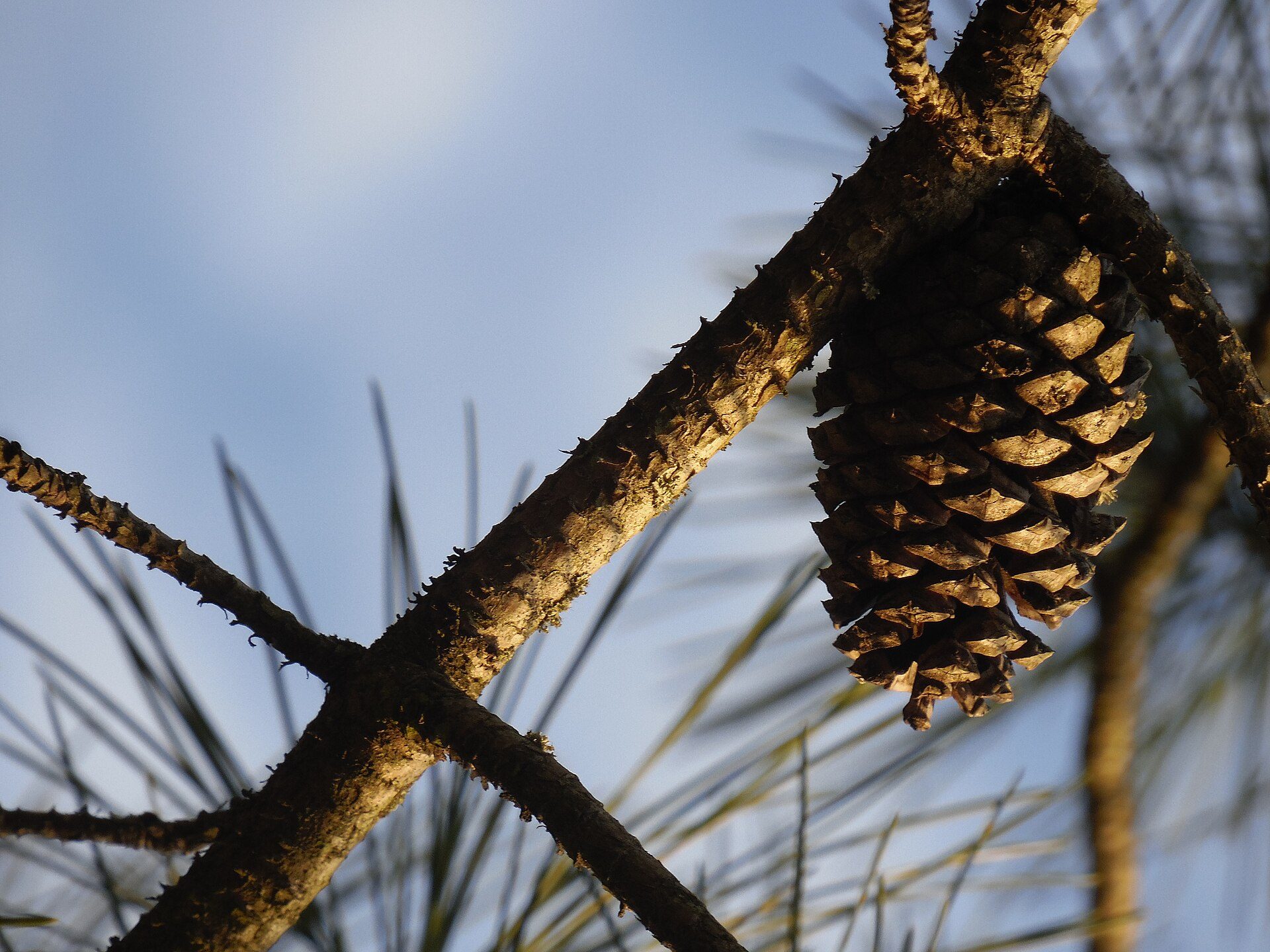
Leave a pine cone on a windowsill and it will open. Put it in water and it will close. Repeat this a hundred times and it will still work. The cone is dead: there are no living cells in it, no metabolism, no signal, no energy input. It is a material that responds to its environment, and it has become one of the most productive templates in materials engineering.
What actually happens
The behaviour was described precisely in a short paper in Nature in 1997 by Colin Dawson and Julian Vincent at the Centre for Biomimetics in Reading, working with Anne-Marie Rocca. Their summary is worth quoting for its economy: the scales of seed-bearing pine cones move in response to changes in relative humidity, gaping open when it is dry and closing up when it is damp. Because the cells in a mature cone are dead, the mechanism is passive: the structure of the scale and the walls of the cells composing it respond directly to the humidity around them.
Dissecting cones of Monterey pine, Pinus radiata, they identified two kinds of scale: the ovuliferous scale and the bract scale. The larger ovuliferous scales continue to respond to changes in humidity even after being removed from the body of the cone. The movement is a property of the individual scale, not of the cone as an assembly.
Why it happens: two tissues, one hinge
The scale behaves as a bilayer, in the same way that a bimetallic strip in a thermostat bends when two bonded metals expand by different amounts.
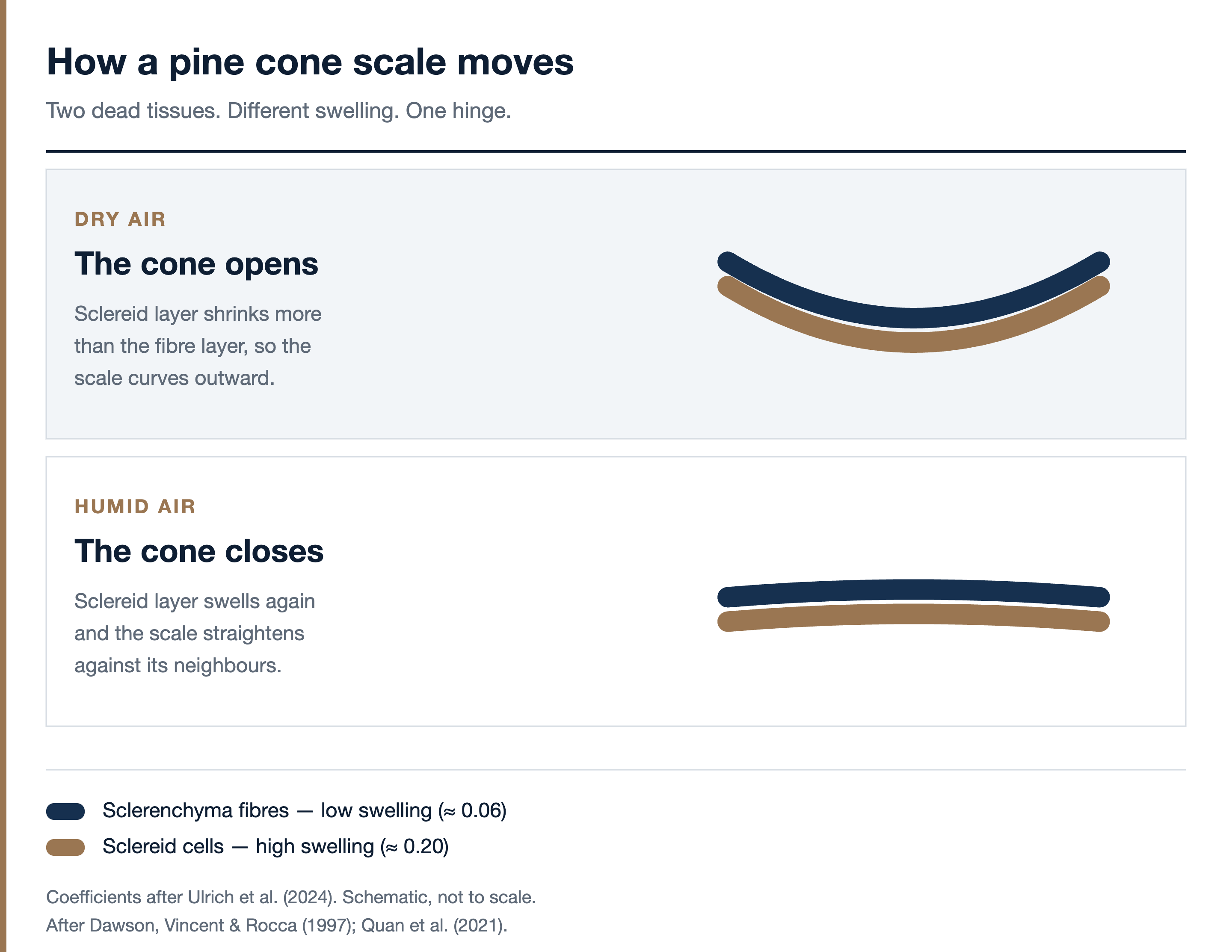
Two tissues are bonded along the length of the scale. On one side sit sclereid cells, which swell and shrink a great deal along the scale axis as they take up or lose water. On the other sit sclerenchyma fibres, which barely change length at all. Both tissues are dead. Both respond to ambient humidity. They simply do not respond by the same amount.
The measured difference is substantial: hygroscopic expansion coefficients of roughly 0.06 for the sclerenchyma fibres against roughly 0.20 for the sclereid cells, a factor of about three. When the air dries, the sclereid layer contracts much more than the fibre layer restraining it, and the scale is forced to curve outwards. The cone opens. When humidity rises, the sclereid layer swells again, the scale straightens, and the cone closes.
The underlying cause
The difference between the two tissues comes down to the microfibril angle: the angle at which cellulose microfibrils are wound around the cell wall. That angle determines how much a lignified cell wall elongates as it takes up moisture. Where fibrils run close to the cell axis, water swells the wall sideways and the cell barely lengthens. Where they are wound at a steeper angle, the same swelling forces the cell to extend. It is the same geometric variable that governs whether wood behaves as a stiff trunk or a flexible twig.
What it is for
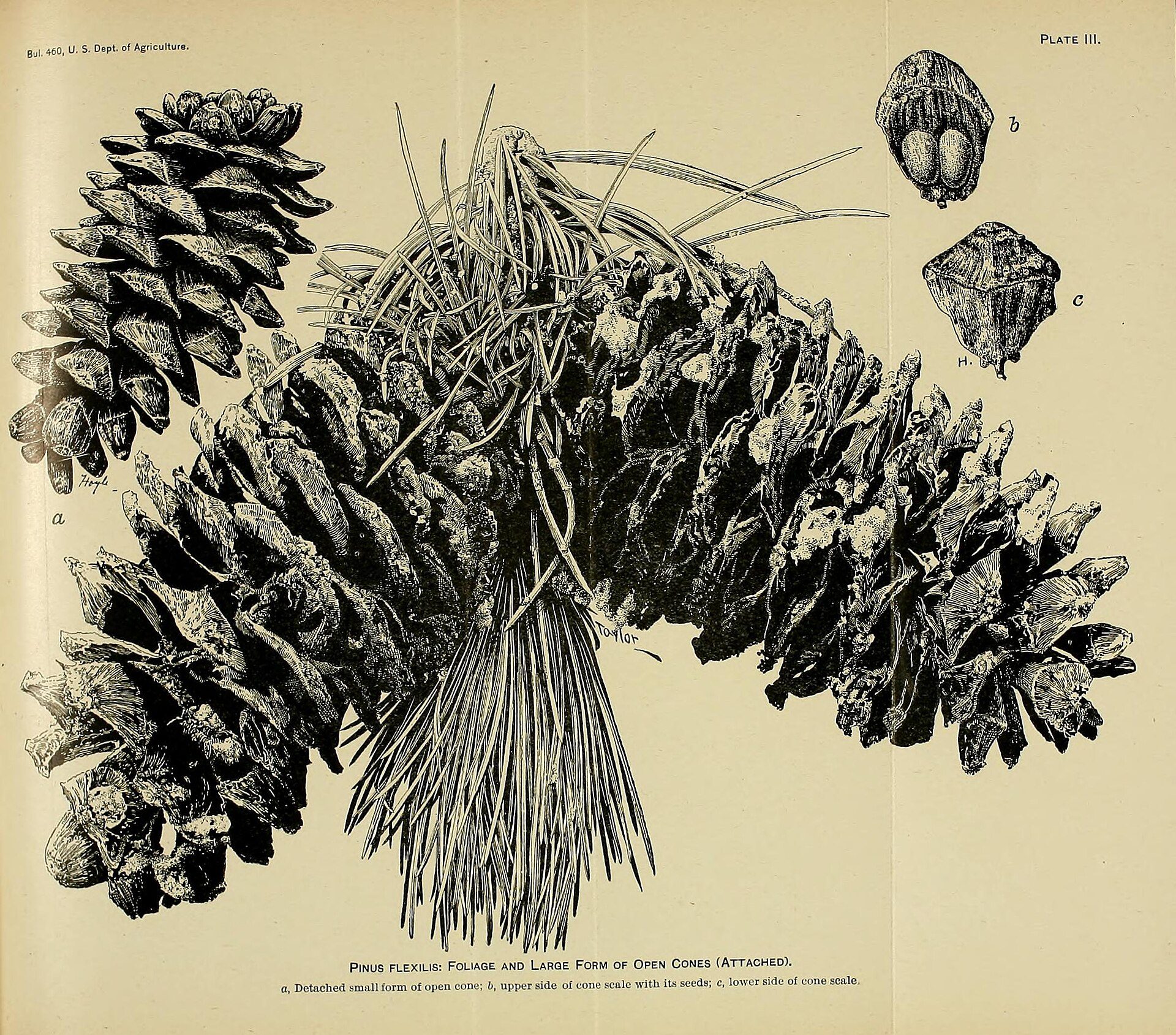
The function is seed dispersal, and the logic is elegant. Dry air is when wind dispersal works: seeds travel further, and they are not going to sit in wet litter and rot. Damp air is when dispersal is least effective. So the cone opens in precisely the conditions that favour release and shuts when they do not.
The tree is therefore running a weather-dependent release mechanism, with no sensor, no controller and no power supply, on a structure it has already finished building and abandoned. The information and the actuation are both embedded in the material.
Is this a responsive material?
Yes, and it is worth being precise about what kind. Responsive or “smart” materials change a property in response to an external stimulus. Most engineered examples need something: piezoelectric actuators need a voltage, shape-memory alloys need a temperature change usually supplied deliberately, electroactive polymers need a circuit.
The pine cone scale is a hygromorph: it changes shape in response to ambient humidity alone. The stimulus is free and ambient. The actuation is the material. There is no distinction between structure, sensor and actuator: they are the same object. Researchers describe it as passive actuation, and the word passive is doing real work: nothing is being spent.
Durability, which is the surprising part
A mechanism made of dead tissue might be expected to fatigue. It was tested. After 102 cycles of submerging and drying, pine cone scales still achieved 97 per cent of their undamaged blocking force and torque, and over 94 per cent of their undamaged opening angle. Cracking within the sclereid layer and extensive delamination of the sclerenchyma fibres were visible, and yet no loss of function was observed in any scale tested. The structure tolerates damage without losing performance, which is a property most engineered actuators would be very glad to have.
The picture is more complex than a bilayer
The bilayer model is the right first explanation, but recent imaging has refined it. Work using synchrotron nano-holotomography and digital volume correlation has shown variation in swelling not only between the two tissues but within them, along with a pronounced hysteresis between sorption and desorption: the material does not follow the same path taking up water as it does giving it off.
Detailed studies have also examined the structural and mechanical basis of the movement, including how water is absorbed and transported through the scale. The mechanism is better described as multilayered and graded than as two clean sheets glued together. This matters for anyone trying to copy it: the simple bilayer captures the direction of motion, but not the full kinetics.
What it has inspired
Adaptive building facades. The most developed application is architectural. Passive, weather-responsive shading systems have been built using the hygroscopic properties of wood, in which elements open and close with ambient humidity without motors, sensors or control systems. A facade that ventilates itself when the air is dry and closes when it is damp is a pine cone scale at building scale.
4D printing. Bio-inspired hygroscopic actuators have been produced by fused deposition modelling, using a hygroscopic filament for one layer and a conventional printing polymer for the other. The printed bilayer bends under changing humidity in direct imitation of its biological model. “4D” here means a printed object whose shape changes over time in response to its environment.
Self-shaping wood. Rather than mimic the mechanism in synthetic polymers, some work uses wood itself, exploiting the natural difference in swelling between layers to make components that form themselves as they dry, reducing the energy and tooling normally needed to bend timber.
Responsive textiles. The original 1997 work was carried out partly with a defence clothing and textiles agency, and the application was obvious from the outset: a fabric whose openings widen as it becomes damp with perspiration and close as it dries would ventilate itself without any active system.
References
- Dawson, C., Vincent, J. F. V. & Rocca, A.-M. (1997). How pine cones open. Nature, 390, 668. doi:10.1038/37745
- Quan, H., Pirosa, A., Yang, W., Ritchie, R. O. & Meyers, M. A. (2021). Hydration-induced reversible deformation of the pine cone. Acta Biomaterialia, 128, 370–383. doi:10.1016/j.actbio.2021.04.049
- Reyssat, E. & Mahadevan, L. (2009). Hygromorphs: from pine cones to biomimetic bilayers. Journal of the Royal Society Interface, 6, 951–957.
- Ulrich, K. et al. (2024). Investigation of the resilience of cyclically actuated pine cone scales of Pinus jeffreyi. Bioinspiration & Biomimetics. doi:10.1088/1748-3190/ad475b
- Ulrich, K. et al. (2025). Beyond the bilayer: multilayered hygroscopic actuation in pine cone scales. Beilstein Journal of Nanotechnology, 16, 119. doi:10.3762/bjnano.16.119
- El-Dabaa, R., Abdelmohsen, S. & Mansour, Y. (2020). Programmable passive actuation for adaptive building façade design using hygroscopic properties of wood. Wood Material Science & Engineering, 16(4), 246–259.
Related reading
This article reflects independent professional analysis and is provided for informational purposes. Quantitative values vary between species, tissues and measurement methods; readers requiring precise figures should consult the primary papers. The diagram is a schematic reconstruction for explanatory purposes and is not to scale. Last reviewed July 2026.