
Bio-based, biodegradable and compostable are routinely used as if they were synonyms. They describe three different things: where a material comes from, what can happen to it in principle, and what has been verified to happen to it under defined conditions. Confusing them leads to unsupportable claims.
Three questions, not one
The clearest way to separate the terms is to recognise that each answers a different question.
Bio-based answers a question about origin: what feedstock the carbon came from.
Biodegradable answers a question about mechanism: whether microorganisms can metabolise the material.
Compostable answers a question about verified outcome: whether the material breaks down completely, within a defined period, under specified conditions, without harming the resulting compost.
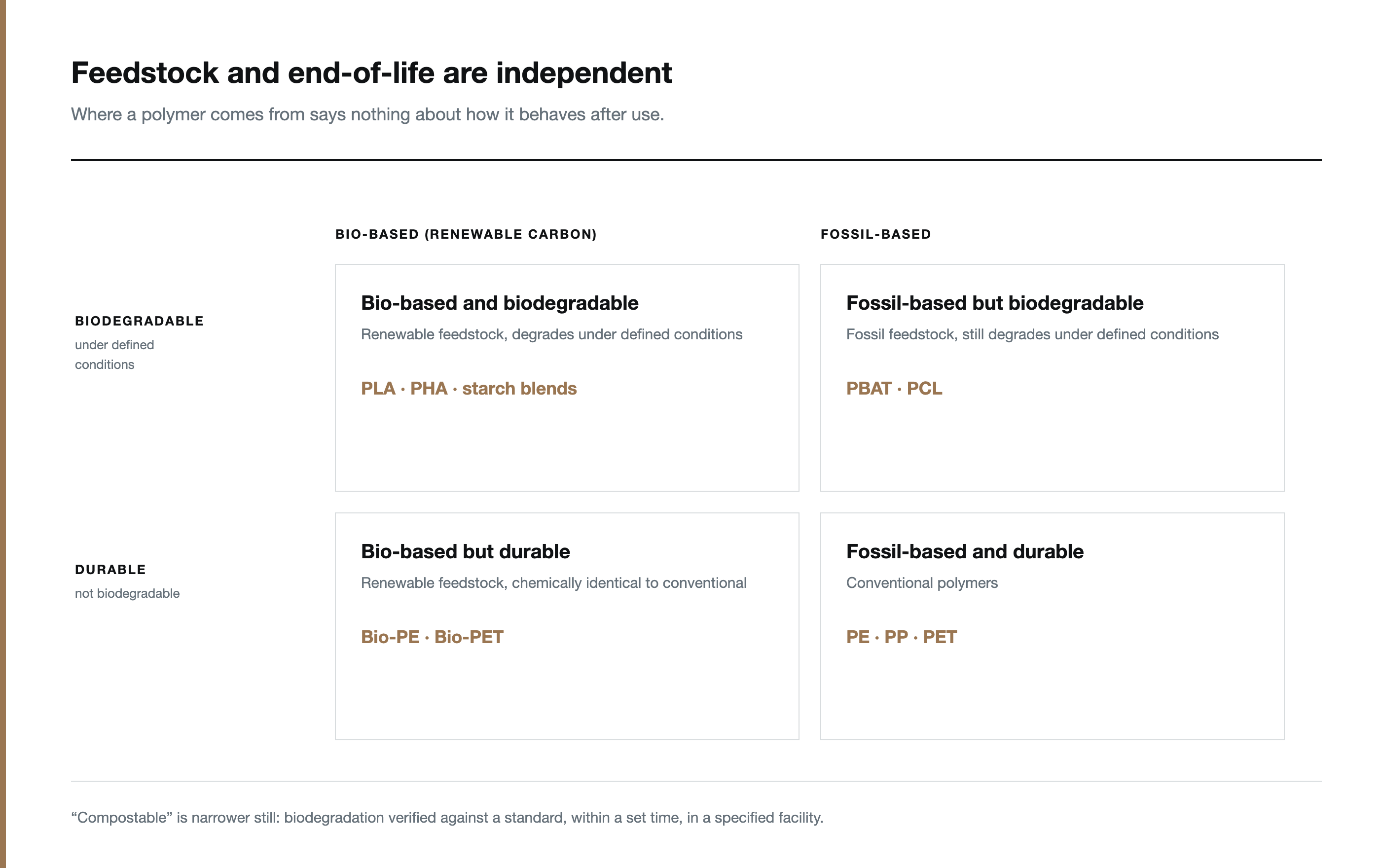
The three properties are largely independent. A material can be bio-based and durable, fossil-based and biodegradable, or bio-based and compostable. Nothing about the feedstock alone determines the end-of-life behaviour.
Bio-based: what it means
Bio-based means that some or all of the carbon in the material derives from renewable biological feedstock (sugarcane, maize, cellulose, vegetable oils, or increasingly agricultural and forestry residues) rather than from fossil resources. It is a statement about the origin of the carbon atoms.
Bio-based content is a measurable quantity rather than a binary state. It is normally expressed as a percentage and determined analytically, with radiocarbon methods distinguishing renewable from fossil carbon. A material described as bio-based may contain anywhere from a small proportion to essentially all renewable carbon, so the figure and the method matter more than the label.
Bio-based does not mean
Biodegradable. Compostable. Recyclable.
Bio-PE and bio-PET are chemically identical to their fossil-derived equivalents: they behave the same in use, the same in a recycling stream, and the same in the environment. The only difference is the origin of the feedstock. Whether a bio-based material carries a lower environmental burden depends on cultivation, land use, processing energy and transport, and can only be established by assessment, not asserted from the feedstock alone. Bio-based and circular material systems, when meeting sustainability criteria, help decarbonise supply chains.
Biodegradable: what it means
Biodegradation is the breakdown of a material by microorganisms into carbon dioxide or methane, water, mineral salts and new biomass. It is a genuine and measurable process. The difficulty is that, used as a bare adjective, the word is close to meaningless, because biodegradation is always conditional on environment and time.
Temperature, moisture, oxygen availability and microbial population all govern whether and how quickly a material degrades. A polymer that mineralises reliably in a heated industrial composting vessel may persist for years in cool soil, in a landfill, or in seawater. Almost any organic material is biodegradable given sufficient time; the question is whether it degrades within a timescale and in an environment that is relevant.
Biodegradable does not mean
Compostable, unless verified against a standard.
It does not mean the item may be littered, nor that it will disappear in the sea or in a hedgerow. An unqualified “biodegradable” claim, with no stated environment, timescale or test method behind it, tells a purchaser almost nothing. Oxo-degradable plastics illustrate the risk: additives promote fragmentation into smaller pieces, which is not the same as mineralisation, and such products are restricted in the EU under the Single-Use Plastics Directive.
Compostable: what it means
Compostable is the most demanding and most precisely defined of the three terms. In Europe the reference standard for packaging is EN 13432, “Packaging — Requirements for packaging recoverable through composting and biodegradation”, which sets a test scheme and evaluation criteria addressing four characteristics: biodegradability, disintegration during biological treatment, effect on the treatment process, and effect on the quality of the resulting compost.
In outline, a packaging item must biodegrade by at least 90 per cent within six months under industrial composting conditions; must disintegrate within twelve weeks such that no more than 10 per cent of material remains in fragments larger than 2 mm; must remain within limits for heavy metals and other hazardous substances; and must not adversely affect the composting process or the quality of the compost, assessed through ecotoxicity and plant growth testing.
Two features of the standard are frequently missed.
- The assessment applies to the packaging as placed on the market, including inks, coatings, adhesives and closures, where a pack combines compostable and non-compostable components, the pack as a whole is not compostable.
- The test conditions that simulate industrial composting does not demonstrate home compostability as home composting operates at lower temperatures.
Compostable does not mean
Home compostable, unless separately verified.
It does not mean the item will degrade in soil, in a landfill or in the marine environment. It has potential but carries limited benefit unless separate bio-waste collection exists and accepts that packaging: a certified compostable item sent to landfill or incineration is not desirable.
Common misconceptions
“It is bio-based, so it will break down.” Feedstock and degradation are unrelated. Bio-PE is polyethylene, whatever the sugarcane origin of its carbon.
“It is compostable, so it is the sustainable option.” Compostability is a route to organic recovery, not a general environmental virtue. Where a format is genuinely recyclable and infrastructure exists, recycling usually retains more material value. Compostability earns its place where recovery of the packaging alongside food residue is the realistic outcome or it can minimise the impact of littering.
“Biodegradable and compostable are the same.” All compostable materials are biodegradable; the reverse does not hold. Compostable is biodegradation qualified by standard, timescale, facility and compost quality.
“Bio-based content counts towards recycled content.” These are distinct concepts with distinct regulatory treatment. Under the PPWR the Commission is required to review the state of technological development and environmental performance of bio-based plastic packaging by 12 February 2028, which may inform future policy, but bio-based feedstock is not presently a substitute for post-consumer recycled content. On how packaging materials are identified in the first place, see material identification codes.
The regulatory direction
Regulation (EU) 2025/40, the PPWR, narrows rather than broadens the role of compostable packaging. The general expectation is recyclability; compostability is treated as the appropriate route only where it delivers a demonstrable benefit, typically where the packaging is inseparable from food residue or is habitually disposed of with bio-waste.
Article 9 requires certain formats to be compostable under industrially controlled conditions by 12 February 2028: permeable tea and coffee bags and similar permeable single-serve units, labels attached to fruit and vegetables, and very lightweight plastic carrier bags. Member States may additionally require compatibility with home composting where national provisions and appropriate bio-waste collection and treatment exist, and may extend compostability requirements to further formats such as non-permeable single-serve units and lightweight carrier bags.
Legal status
Regulation (EU) 2025/40 is adopted and in force, applying generally from 12 August 2026, with the Article 9 compostability requirements applying from 12 February 2028. Standardisation work is ongoing: there is at present no harmonised European standard for home compostability, and the Commission is expected to request its development alongside revision of EN 13432. The position on home compostability should therefore be treated as developing.
Practical guidance
Specify precisely. State bio-based content as a percentage with the determination method. State compostability by reference to the standard, the certification body and whether it covers industrial or home conditions. Treat any unqualified “biodegradable” claim as incomplete until the environment, timescale and test method are supplied.
Above all, match the property to the recovery route that will actually be available where the packaging is discarded. A certified compostable tray is only compostable in practice if the local system collects and processes it. Material properties and infrastructure have to be considered together, or the claim on the pack and the outcome in the waste stream will diverge.
References
- EN 13432:2000, Packaging — Requirements for packaging recoverable through composting and biodegradation — Test scheme and evaluation criteria for the final acceptance of packaging.
- Regulation (EU) 2025/40 of the European Parliament and of the Council on packaging and packaging waste, in particular Article 9. EUR-Lex
- Directive (EU) 2019/904 on the reduction of the impact of certain plastic products on the environment (Single-Use Plastics Directive). EUR-Lex
- ISO 14855-1, Determination of the ultimate aerobic biodegradability of plastic materials under controlled composting conditions.
Related reading
This article reflects independent professional analysis and is provided for informational purposes. It does not constitute legal advice or an official position of any organisation. Standardisation and implementing measures in this area are developing; readers should verify the current position against the consolidated legal texts and the current versions of the standards cited. Last reviewed July 2026.