
We know latex as a commodity: gloves, tyres, adhesives, elastic. That framing obscures what it actually is. Latex is a defence system: a pressurised, self-deploying wound-sealing mechanism that has evolved independently many times across the plant kingdom. Understanding it as defence rather than as raw material explains almost everything about how it behaves.
Not a rubber tree problem
The plant most associated with latex is the Pará rubber tree, Hevea brasiliensis. But there are thousands of latex-bearing species (estimates exceed twenty thousand) spread across many unrelated families, in herbs, shrubs and trees. Latex occurs in leaves, stems, fruits and roots.
That distribution is the first clue. Laticifers, the vessels that carry latex, have evolved independently multiple times. When evolution arrives repeatedly at the same solution in unrelated lineages, the solution is usually answering a persistent and serious problem.
The problem: a plant cannot run
An animal facing injury can flee. A plant cannot. It is confined to defences that work in place: thorns, toxins, tough tissue, and repair. Every organism has evolved some capacity for self-repair, but a plant needs its repair to be immediate, local and autonomous, because there is no circulatory system to rush materials to a wound and no nervous system to signal that one has occurred.
Latex answers all three requirements at once, and it does so with a design decision that is worth stating plainly.
The core idea
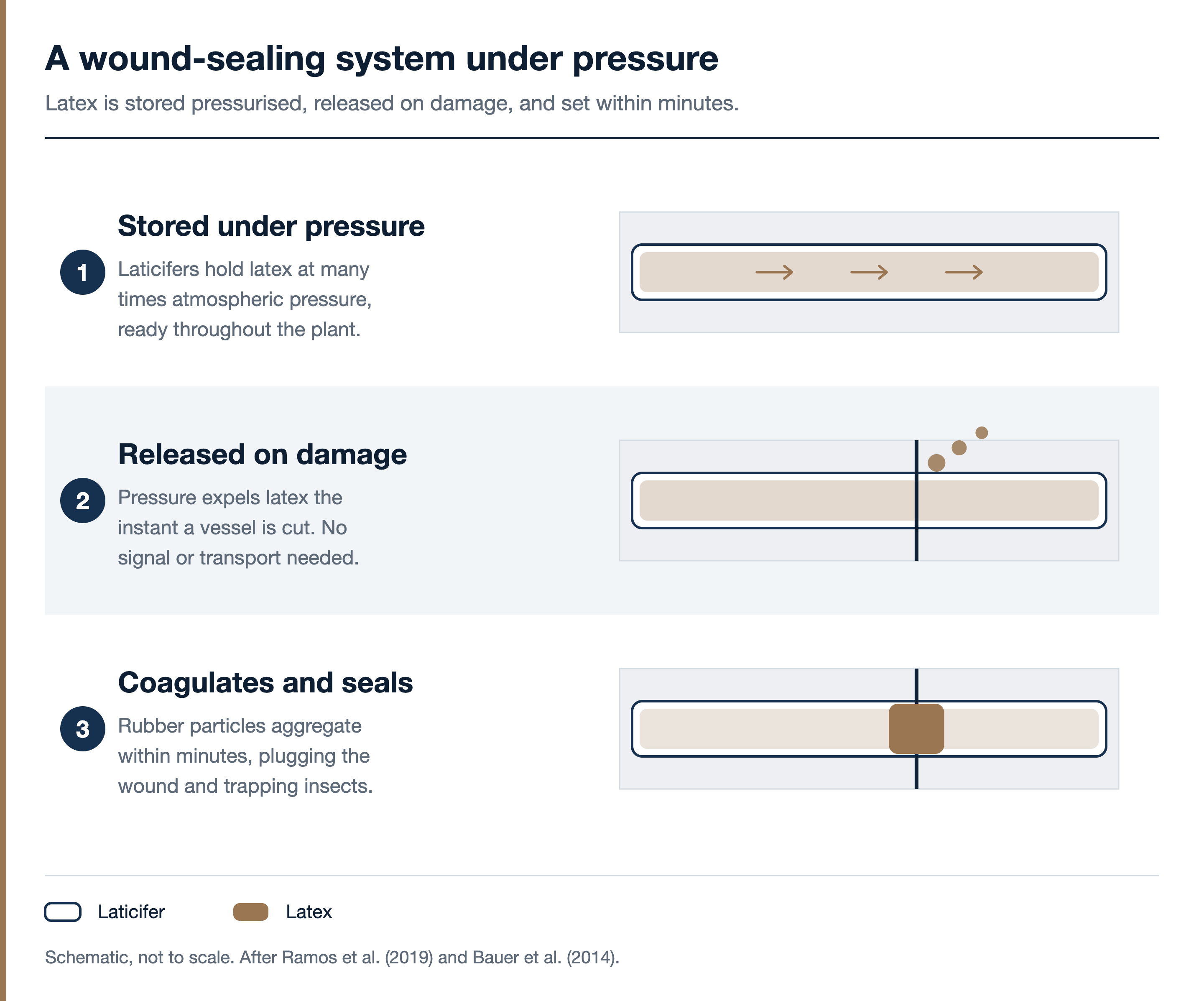
The plant does not respond to damage. It pre-positions the response. Latex is manufactured in advance and stored throughout the tissue under pressure, so that injury itself, not any subsequent detection or signalling, is what deploys it. The wound triggers its own sealing.

Stored under pressure
Laticifers are tube-shaped structures formed by a cell or a group of cells, distributed through the plant and holding latex under considerable turgor. In the rubber tree, the turgor pressure of laticifers before tapping has been reported at ten to fifteen times atmospheric pressure. That pressure is the driving force that expels latex the moment a vessel is severed.
It is a purely mechanical trigger. No receptor identifies the injury, no signal travels, no metabolic response is mounted before the material arrives. The energy was invested earlier, during manufacture and pressurisation, and it is released by the damage itself.
Setting on contact
Exudation alone would achieve little; the material must set. On exposure to air, latex undergoes a rapid coagulation-like process, observed within a few minutes in species such as papaya. The rubber particles aggregate, and it is that aggregation which seals the wound.
In Hevea, rubber particles may constitute up to half the latex by volume, each particle a globule of cis-polyisoprene surrounded by a phospholipoprotein membrane. The white colour of latex comes from these particles. Their accepted role is to confer self-stickiness, through the elasticity of cis-polyisoprene, the coagulation of the particles themselves, and their adhesiveness to insect surfaces.
Proteins participate too. Hevein, a lectin-like protein from the rubber tree, is involved in latex coagulation, and protein networks formed by physical interaction contribute to the rapid occlusion of laticifers after wounding.
One mechanism, several jobs
Physical defence. The adhesive properties of latex can immobilise small insects outright, or gum up the mouthparts of caterpillars and reduce their feeding efficiency. The seal is also a trap.
Microbial defence. A sealed wound cannot be colonised as readily as an open one. Latex has increasingly been examined as a defence against pathogens rather than only against herbivores, with the physical barrier and the chemistry of the exudate both contributing.
Water conservation. For species in arid climates, the critical requirement after injury is not defence against animals but the prevention of water loss. The same sealing function serves a different purpose.
Tuned to the environment
Because the priority differs by habitat, latices differ too. Species exhibit a diverse array of latex types, each in accordance with the main selective pressure its producer faces after injury. In arid environments minimising water loss dominates; in tropical ecosystems strong chemical defence against herbivores, parasites and germs is more urgent. That diversity of environments is mirrored by diversity in chemical composition, material properties and coagulation times.
The coagulation mechanisms differ as well. Some species rely simply on evaporation. Comparative work using cryo-scanning electron microscopy and laser diffraction has found similar particle sizes in Ficus benjamina and Hevea, suggesting comparable chemical coagulation, while other species appear to use a physical mechanism instead. Testing in a pressure chamber showed Campanula latex coagulating at eight bar, a pressure at which Ficus coagulation is impaired: evidence of a genuinely different pathway.
A caution on generalising
Of more than twenty thousand latex-bearing species, comprehensive comparative studies of coagulation are lacking, and detailed understanding rests heavily on Hevea. Statements about “how latex works” are usually statements about how one commercially important species works. The mechanism is plural.
What it inspires
Biological latices are an explicit model for fast self-repair, and have informed the development of bio-inspired self-healing polymers. The attraction is the architecture rather than the chemistry: a healing agent stored in advance within the material, released by the damage event itself, setting rapidly without external intervention. A comparable logic of built-in recovery operates at molecular scale in the wood cell wall.
Engineered self-healing systems that encapsulate a healing agent in microcapsules dispersed through a matrix follow precisely this logic. A crack ruptures the capsules, the agent flows into the crack and polymerises. The plant arrived at the design first, and pressurises its reservoir so that delivery does not depend on capillary action alone.
References
- Agrawal, A. A. & Konno, K. (2009). Latex: a model for understanding mechanisms, ecology, and evolution of plant defense against herbivory. Annual Review of Ecology, Evolution, and Systematics, 40, 311–331.
- Ramos, M. V. et al. (2019). Laticifers, latex, and their role in plant defense. Trends in Plant Science, 24, 553–567.
- Review: Laticifer as a plant defense mechanism. Plant Science. ScienceDirect
- Bauer, G. et al. (2014). Comparative study on plant latex particles and latex coagulation in Ficus benjamina, Campanula glomerata and three Euphorbia species. PLOS ONE. PLOS ONE
- Toward understanding the fast latex coagulation in Campanula spp. Integrative Organismal Biology. Oxford Academic
- Gidrol, X., Chrestin, H., Tan, H.-L. & Kush, A. (1994). Hevein, a lectin-like protein from Hevea brasiliensis, is involved in the coagulation of latex. Journal of Biological Chemistry, 269, 9278–9283.
- Latex — a potential plant defense against microbes. Trends in Microbiology. ScienceDirect
Related reading
This article reflects independent professional analysis and is provided for informational purposes. Latex composition and coagulation behaviour vary widely between species; findings from Hevea brasiliensis should not be assumed to generalise. The diagram is a schematic reconstruction and is not to scale. Last reviewed July 2026.