
Most people never think about technical standards, and fewer still have read one. Yet these documents decide whether a toy is safe, whether a cloth meets its limits, whether a machine may be sold. In many cases they carry the force of law, and until recently, you had to pay to read them.
Two judgments of the Court of Justice of the European Union have now unsettled that arrangement. Together they establish a simple principle with far-reaching consequences: where a standard functions as law, the public must be able to read it for free. That resolves a longstanding democratic problem, and opens a financial one that the European standardisation system has not yet answered.
How a private document becomes public law
The European Standardisation System rests on a bargain struck in the 1980s under the “New Approach” and now codified in Regulation 1025/2012. The EU legislator sets essential requirements (a product must be safe, a substance must stay below a limit) in broad terms. The technical detail of how to meet them is written by private bodies: the European Standardisation Organisations, CEN, CENELEC and ETSI, working at the Commission’s request.
The Commission then reviews the result and publishes a reference to the standard, not its text, in the Official Journal. From that moment, a manufacturer who follows the standard enjoys a presumption of conformity with the law. In theory the standard is voluntary; in practice, with no affordable alternative route to market, it is very often the only way to comply. And its full text sat behind copyright and a fee set by the national standards bodies.
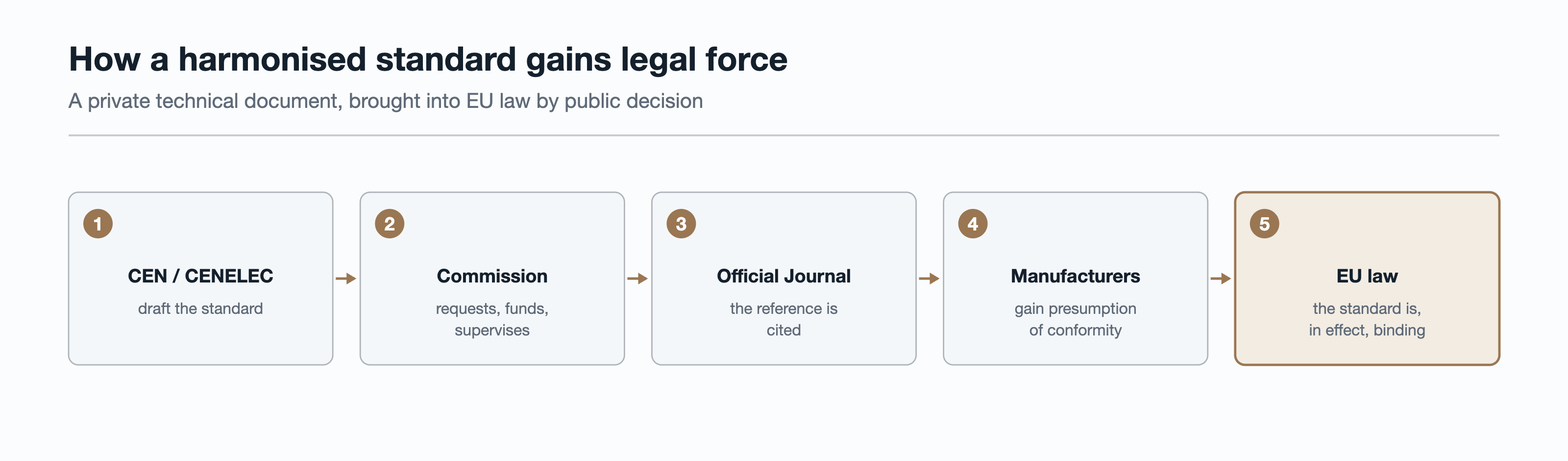
A harmonised standard is drafted privately, then brought into EU law by public decision, which is why the Court came to treat it as law.
The access problem
A rule that binds the public must be knowable by the public. Yet the standards that give EU law its practical meaning were sold, not published, readable only by those who could pay.
The Malamud ruling: standards are part of EU law
The question reached the Court through two transparency campaigners. In 2018, Public.Resource.Org and Right to Know asked the Commission for four harmonised standards underpinning the Toy Safety Directive and the REACH Regulation, relying on the EU’s access-to-documents rules. The Commission refused, citing the standards bodies’ copyright and the absence of any overriding public interest. The General Court agreed. The applicants appealed.
On 5 March 2024, in Case C-588/21 P, the Court sided with the applicants. Its reasoning was structural. Although standards are drafted by private bodies, it is the Commission that initiates, finances and supervises the work, sets its content and deadlines, and decides to publish the reference, so it is the Commission that brings the standard into EU law. Because these standards produce mandatory legal effects, whether directly or through the presumption of conformity, they specify individual rights and obligations. And EU law, the Court held, must be freely accessible: the rule of law and the principle of transparency require it. The refusal was annulled.
The 2026 follow-up: international standards too
The principle did not stop at CEN and CENELEC. On 21 April 2026, in Case C-155/24, the Court extended it to international standards referenced in EU legislation. The case concerned the Tobacco Products Directive, which relies on ISO measurement methods to control emission limits in cigarettes. The Court held that where a directive refers to such standards, individuals must be able to access them and that access must be free, effective, free of charge and non-discriminatory so that anyone can check whether the law is being met. The standards remain binding even where they have not been published in the Official Journal.
The judgment also pointed, for the first time, toward an answer on cost. Because it is the EU legislator that imposes the obligation to apply these standards, the Court indicated that it is the EU that must bear the cost of providing free access to their official and binding versions, particularly where they are protected by intellectual property rights.
What it means for the standardisation bodies
The system was, in part, funded by selling standards. Free access challenges that model directly. In response, the national bodies moved first: after the 2024 ruling they established controlled “Access Solution” reading platforms that let the public view referenced standards without removing copyright. Following the 2026 judgment, CEN and CENELEC welcomed the decision, arguing that it confirms their approach is compatible with EU law, that copyright over standards remains intact even when they become legally binding, and that access can be provided through existing document rules and national adoption rather than by publishing full texts in the Official Journal.
The operating model, in other words, is shifting from selling copies toward providing supervised free access, with the bodies retaining authorship and control, and the question of funding pushed upward, toward the institutions that mandate the standards in the first place.
Who finances the standards then?
This is the unresolved core of the matter. Drafting a standard is expensive, and much of that expense was recovered through sales. If the public cannot be charged, the money must come from elsewhere, and the 2026 ruling suggests the EU, as the party imposing the obligation, should carry it. But the accounting is not simple. Harmonised standards frequently incorporate ISO and IEC material, reference other standards, and can depend on patented technology held by third parties; compensating every layer of intellectual property could prove costly. And if standard-setting becomes unremunerated, the bodies that do the work may have less incentive to do it.
Balancing free public access against a sustainable financing model is now the pending exercise, and it arrives as the Commission is already reviewing Regulation 1025/2012, the statute that governs the whole system.
Why it matters beyond compliance
Free access is not only a convenience for manufacturers. It lets researchers, consumer groups, journalists, smaller firms and citizens read the rules that govern the products around them, and check whether those rules are being met. That scrutiny grows more important as standards take on heavier work in newer regulation, from ecodesign to the framework standards that will operationalise the AI Act. Rules that shape public safety and fundamental rights are more trustworthy when they can be read by the public they bind.
In short
- Standards can be law. Through the presumption of conformity, harmonised and referenced standards acquire binding legal effect.
- The Court has ruled they must be free. C-588/21 P (2024) for harmonised standards; C-155/24 (2026) for ISO standards in directives.
- The operating model is shifting: from selling copies toward supervised free access, with copyright retained by the bodies.
- The open question is who pays. The Court points to the EU; the financing model is now under review alongside Regulation 1025/2012.
References
- Court of Justice of the EU, Public.Resource.Org and Right to Know v Commission, Case C-588/21 P, judgment of 5 March 2024.
- Court of Justice of the EU, Case C-155/24, judgment of 21 April 2026 (ISO standards referenced in the Tobacco Products Directive 2014/40/EU).
- Regulation (EU) No 1025/2012 on European standardisation; the 1985 “New Approach”. EUR-Lex.
- A. Soroiu, “The Fall of the Great Paywall for EU Harmonised Standards”, Verfassungsblog (2024); IBF Solutions, technical note on Case C-155/24 (2026); CEN-CENELEC statements (2024, 2026).
Read further
- Aseptic packaging: the food is sterilised before it ever reaches the carton
- The circular bioeconomy: why circularity and the bioeconomy need each other
This article reflects independent professional analysis and is provided for informational purposes. It is not legal advice. Case references and dates are drawn from the sources listed above. Last reviewed July 2026.