
You have almost certainly bought it without thinking about it: a carton of milk, juice or plant drink taken from an unrefrigerated shelf, carried home in a warm bag, and left in a cupboard for months before it is opened. Nothing about it seems remarkable until you stop to ask why it has not spoiled.
The usual explanations are wrong. It is not full of preservatives: most aseptic products contain none. What keeps the food safe is a carefully engineered process, and the package is the part of that process that keeps the result intact. The name for the whole system is aseptic packaging, and it is one of the most quietly important technologies in the modern food supply chain.
What “aseptic” actually means
Aseptic processing and packaging means filling a commercially sterile product into a separately sterilised container, then sealing it hermetically with a sterilised closure, in an environment that keeps microorganisms out. That is close to the wording used by both the Codex Alimentarius code of practice and the US Food and Drug Administration, and the important word in it is separately.
“Commercially sterile” does not mean absolutely lifeless. It means free of any microorganisms able to grow under the normal, non-refrigerated conditions the product will meet in storage and distribution. A few highly heat-resistant spores may survive; what matters is that they cannot multiply at ambient temperature, so they neither spoil the food nor make it unsafe.
THE KEY DISTINCTION
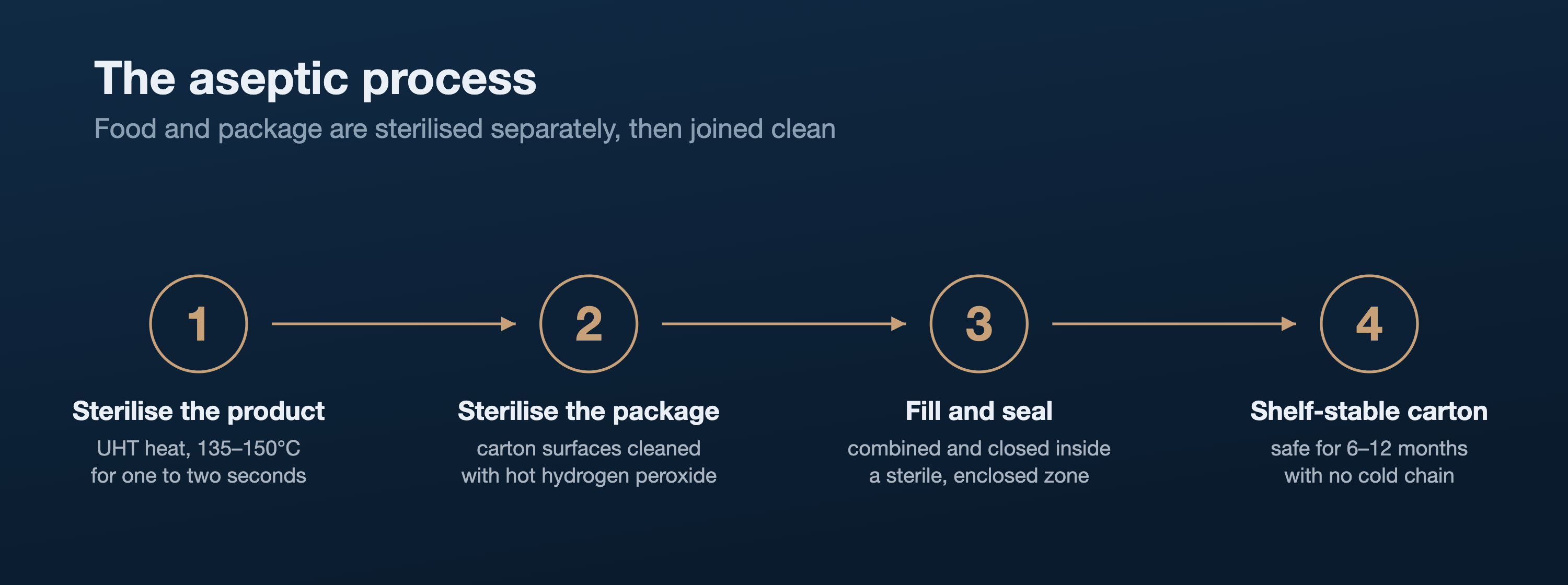
A can is filled first and cooked afterwards: the food is sealed inside the container and then heated. Aseptic processing reverses the order. The food and the package are sterilised apart, then brought together and sealed clean. The container is the last step, not the sterilising one.
A short, intense heat: not a long one
Most aseptic liquids are treated by ultra-high-temperature (UHT) processing: the product is heated to roughly 135–150°C for a second or two as it flows through a heat exchanger, then cooled quickly. Because the heat is brief, it destroys spores while doing far less damage to flavour, colour and nutrients than the long cook a retort or a can requires. That is why shelf-stable UHT milk tastes closer to fresh milk than to tinned.
The package: the liquid packaging carton
The most familiar aseptic package is the beverage carton, and it is a good example precisely because it looks so ordinary. It seems to be paper, and mostly it is: around 75% paperboard, about 20% polyethylene and roughly 5% aluminium foil, laminated into a wall of about six thin layers. Each material does one job:
- Paperboard gives the pack its stiffness and shape, and is the renewable bulk of the material.
- Thin polyethylene layers seal the carton, bond the other layers, and keep moisture out.
- A foil layer thinner than a human hair blocks the light and oxygen that would otherwise degrade the contents.
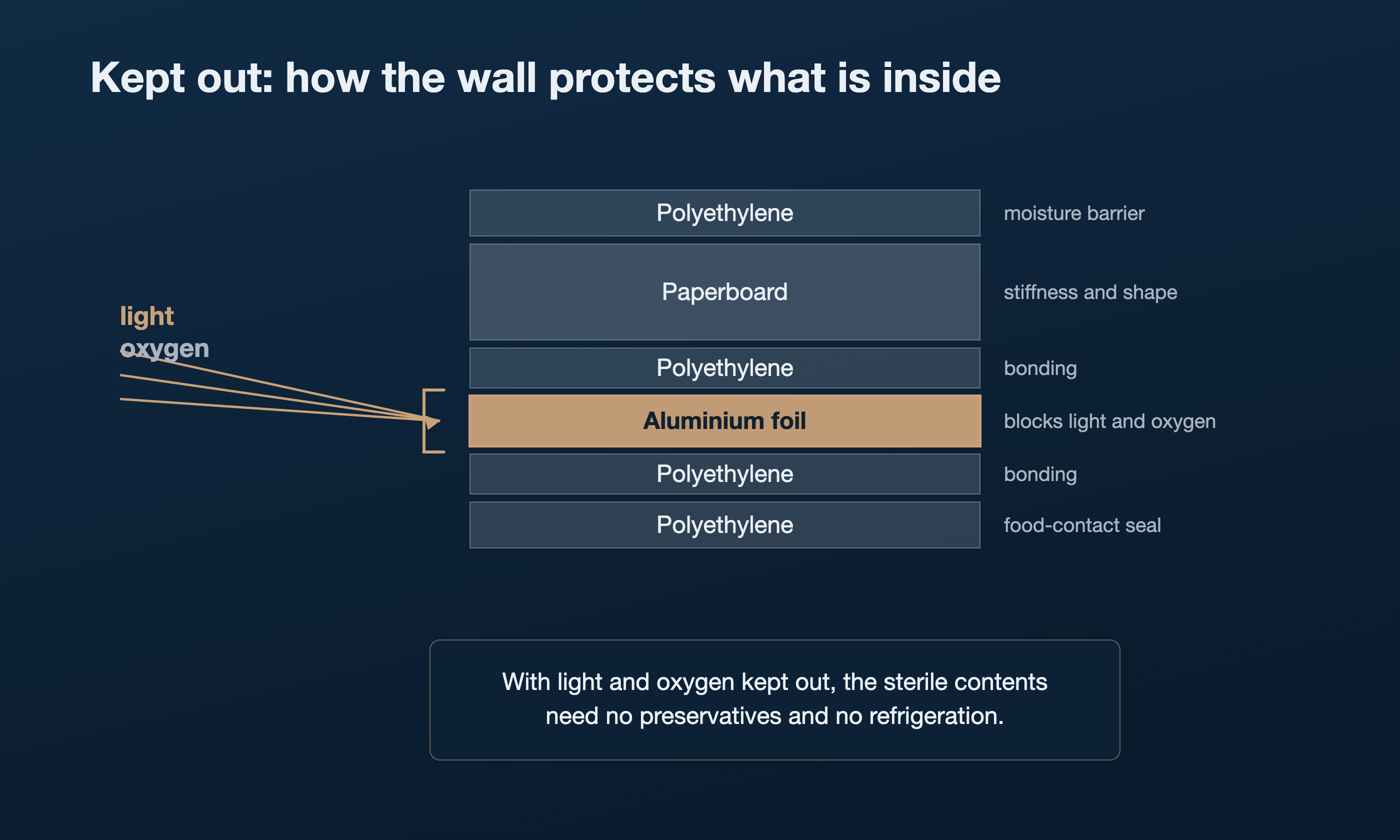
The empty material is sterilised inside the filling machine (typically with hot hydrogen peroxide) as the carton is formed, filled and sealed in one continuous, enclosed operation. What comes out is a hermetically sealed pack holding a commercially sterile product.
The format is not new. The aseptic carton reached the mass market with the Tetra Brik Aseptic in 1969; the name of the company that introduced it comes from the original tetrahedral carton shape. What began as a way to move milk without heavy glass bottles became one of the most widely used food packages in the world.
Why it matters: safety without a cold chain
Here is the consequence that makes aseptic packaging important rather than merely clever. A sealed, commercially sterile carton is shelf-stable: it can sit at ambient temperature for six to twelve months without refrigeration and without spoiling.
That removes the cold chain: the unbroken sequence of refrigeration from factory to lorry to warehouse to shop to home that chilled food depends on. A cold chain is expensive, energy-hungry and fragile; one broken link and the food is compromised. Aseptic packaging does not need one at all.
Where infrastructure is thin
This is where the technology earns its place. In regions where reliable power, refrigeration and continuous transport cannot be assumed, and in any situation where supply chains are strained, from a remote rural market to a disaster response, shelf-stable cartons let safe milk, juice and ready-to-drink nutrition reach people who otherwise could not be served. The product can be stocked, stored and moved without a freezer at any point, and it stays safe until the moment it is opened. It is one of the quiet reasons a nutritious drink can be delivered to places a refrigerated one never reaches.
Affordable, and easy to stock
The economics follow from the same properties. The pack is light and mostly paper, so it is inexpensive to make and cheap to ship. There is no refrigeration cost anywhere along the chain. The long shelf life means less spoilage, less waste, and stock that can be held until it is needed rather than sold against a short clock. For the people at the end of the chain, that combination (low unit cost, long life, no special storage) is what turns a packaging technology into reliable access to safe food.
The brick that stacks
There is also a plain geometric advantage, and it is easy to underrate. A rectangular carton, the “brick”, tessellates. Packed side by side, bricks leave almost no empty space, whereas round bottles and cans surrender roughly a fifth of every case and pallet to the gaps between cylinders. More product travels in the same lorry and sits on the same length of shelf. The empty packaging ships flat, as reels of material, so even the unfilled cartons are efficient to transport before they are ever formed. In logistics, density of that kind is not a cosmetic detail: it is often the difference between one delivery and two.
Is this a universal solution?
It is worth being clear about what aseptic packaging is: a highly specialised, precisely engineered system, developed and refined over decades primarily for the food and beverage industry. Its value lies in doing one demanding job exceptionally well: delivering safe, shelf-stable liquid food to almost anywhere, without a cold chain and without preservatives. That focus is a strength, not a limitation.
It is not intended to be the answer to every packaging question, and it does not need to be. It is optimised for liquids and pourable products, and it draws on sophisticated filling technology and well-established supply and recovery systems. Where those conditions are met, few formats can match it for safety, reach and efficiency. Seen correctly, the liquid packaging carton is not a compromise but a purpose-built solution: one of the clearest examples of engineering matched precisely to a need.
In short
- Aseptic does not mean preservatives. Shelf stability comes from sterile processing and a sealed barrier, not additives.
- The process makes the food safe; the package keeps it that way. Both halves matter, and neither works without the other.
- Its defining benefit is the removal of the cold chain, which is exactly why it matters most where refrigeration cannot be assumed.
- It is a purpose-built solution: a specialised, engineered format that delivers safe, affordable, shelf-stable liquid food at scale.
References
- Codex Alimentarius, Code of Hygienic Practice for Aseptically Processed and Packaged Low-Acid Foods, CAC/RCP 40-1993. FAO/WHO, definitions of aseptic processing and commercial sterility.
- US FDA, 21 CFR Part 113 — Thermally Processed Low-Acid Foods Packaged in Hermetically Sealed Containers, §113.3. eCFR, regulatory definition of aseptic processing and packaging.
- G. L. Robertson, work on the beverage carton and Food Packaging: Principles and Practice, on carton structure and the introduction of the Tetra Brik Aseptic (1969).
- Technical and industry sources on aseptic carton composition (approx. 75% paperboard / 20% polyethylene / 5% aluminium) and hydrogen-peroxide sterilisation of packaging material.
Read further
- Bio-based, biodegradable, compostable: three terms that are not interchangeable
- Material identification codes: what they mean, what they do not, and how the PPWR changes them
- Composite packaging under the PPWR: a legal boundary, not a scientific one
This article reflects independent professional analysis and is provided for informational purposes. It is not commercial or dietary advice, and any mention of a specific format or product is illustrative rather than an endorsement. Last reviewed July 2026.