
Tear open a bag of crisps and the first thing you notice is how little of it is crisps. The bag is fat with air, the contents rattle around inside a space built for twice as much, and the obvious question follows: are we buying food, or are we buying air?
It is a fair question, and it already has a legal answer. Since 1994, U.S. federal law has drawn a line between packaging that is deceptively empty and packaging that is empty on purpose. The rule is called the slack-fill regulation, and it turns out the crisp bag sits on the right side of that line, for a reason that has nothing to do with cutting corners.
The law already asked whether they are selling you air
Under 21 CFR 100.100, the FDA regulation on misleading containers, “slack-fill” is simply the gap between a package’s full capacity and how much product is actually inside. Some of that gap is indefensible: a box sized to look bigger on the shelf than its contents justify. The regulation calls that non-functional slack-fill, and treats it as a form of misbranding.
But the same rule lists specific reasons empty space can be entirely legitimate, and the first one on the list is protection of the contents. A cushion of gas that stops a fragile product from crushing itself in transit is not a trick. It is engineering, and the regulation says so in plain terms. That single exemption is the reason a half-empty crisp bag and an over-boxed gadget are not the same complaint, even though they can look similar on a shelf.
Once you know to look for it, that engineered air turns out to be doing far more than cushioning crisps. In fresh food it is closer to a preservative than a packing material, and the technology behind it has a name: modified atmosphere packaging, or MAP.
What MAP actually is
Ordinary air is roughly 78% nitrogen, 21% oxygen and a trace of carbon dioxide. MAP deliberately alters those proportions before the pack is sealed, and picks the mixture to suit the product going inside it. Most often the air is drawn out and the pack is flushed with a chosen gas blend, a method called active MAP. Sometimes the film itself is engineered to be selectively permeable, so the atmosphere inside settles into the right balance on its own as the product breathes: passive, or equilibrium, MAP. Either way, the plastic is just the container. The atmosphere sealed inside it is the part doing the work.
Three gases, three jobs
Almost all MAP is built from the same three gases, and each one is assigned a distinct job rather than being there to fill space.
- Oxygen is usually the enemy: it feeds the aerobic bacteria that spoil food, and it oxidises fats and pigments. Most MAP removes as much of it as possible. The one deliberate exception is fresh red meat, where a little oxygen is wanted because it keeps the surface a bright red that shoppers read as “fresh.”
- Carbon dioxide is the actual preservative. It dissolves into the moisture on the food’s surface, mildly acidifies it, and acts as a bacteriostat that slows the growth of spoilage microbes. Its limit is mechanical, not chemical: push much past 40% and it starts dissolving into the food itself, which can make the pack visibly collapse.
- Nitrogen does no chemistry at all. It is inert filler: it displaces oxygen, occupies the headspace, and, because it is not absorbed by the food, holds the pack’s shape and cushions whatever is fragile enough to need cushioning.
The three gases, in one line
Oxygen: colour for red meat, spoilage for almost everything else. Carbon dioxide: the preservative. Nitrogen: the inert filler that holds the pack.

MAP flips the composition of ordinary air: nitrogen for crisps, high oxygen with carbon dioxide for red meat, nitrogen with carbon dioxide for poultry and fish.
The crisp bag: nitrogen against rancidity
For crisps and most snacks, the enemy is not bacteria but oxidation, the slow reaction between oxygen and fat that turns them rancid, plus the simple mechanical risk of crushing. The fix is to flush the bag with nitrogen, often close to pure, driving out the oxygen before the seal closes. With almost none left, the fats stay edible for months instead of weeks, and the gas cushion absorbs the shocks of a supply chain that was never going to treat the bag gently. That half-empty bag is not cost-cutting. It is, by the FDA’s own definition, functional slack-fill: the specific kind of empty space the regulation exists to protect.
The meat tray: oxygen for colour, CO₂ for safety
A retail tray of fresh red meat has a harder problem: it has to look right under supermarket lighting as well as stay safe to eat. The standard response is high-oxygen MAP, typically in the range of 70 to 80% oxygen with 20 to 30% carbon dioxide. A 2018 study in the Journal of Food Science and Technology tested lamb across a wider range of ratios, from 15% up to 60% oxygen, and found 45% oxygen with 55% carbon dioxide gave the best combination of shelf life and consumer preference, extending it to 14 days while keeping lipid oxidation in check.1 The mechanism is consistent across these studies: oxygen converts the meat’s surface pigment into bright-red oxymyoglobin, the colour shoppers associate with freshness, while carbon dioxide’s bacteriostatic effect slows the organisms that would otherwise spoil it. It is a deliberate trade-off, since the same oxygen that preserves the colour also drives the oxidation that can eventually dull flavour and toughen texture.
Where colour is not the point, in poultry, fish, and cooked or sliced meats, the oxygen comes out almost entirely. Low-oxygen mixes, typically around 70% nitrogen with 30% carbon dioxide, avoid the oxidation penalty altogether and can extend cooked and sliced meats to many weeks rather than days.
Fresh produce: packaging that has to breathe
Fruit and vegetables are still alive after harvest. They keep respiring, taking in oxygen and giving off carbon dioxide, so sealing them into a fixed atmosphere would suffocate them. Equilibrium MAP solves this by tuning the film’s permeability so gases move in and out at close to the rate the produce itself needs, settling into a low-oxygen, higher-carbon-dioxide balance that slows ripening without stopping it outright. A 2025 study in the International Journal of Food Science and Technology tested this on strawberries, comparing three active MAP blends against conventional packaging: the best-performing mix, roughly 10% oxygen, 15% carbon dioxide and 75% nitrogen, showed no fungal decay through 15 days of storage, while the conventionally packaged control was visibly mouldy by day 13.2 Here the film is not really a wall. It is closer to a valve, and the case for calling the headspace “functional” is at its clearest: without it, the produce would suffocate faster than it would spoil.
What it buys: shelf life, and a case for the numbers
The payoff across all of this is time. By slowing the two clocks that run against fresh food, microbial growth and oxidation, MAP can multiply shelf life several times over, though the exact gain depends on the product, hygiene, temperature and the barrier properties of the film.
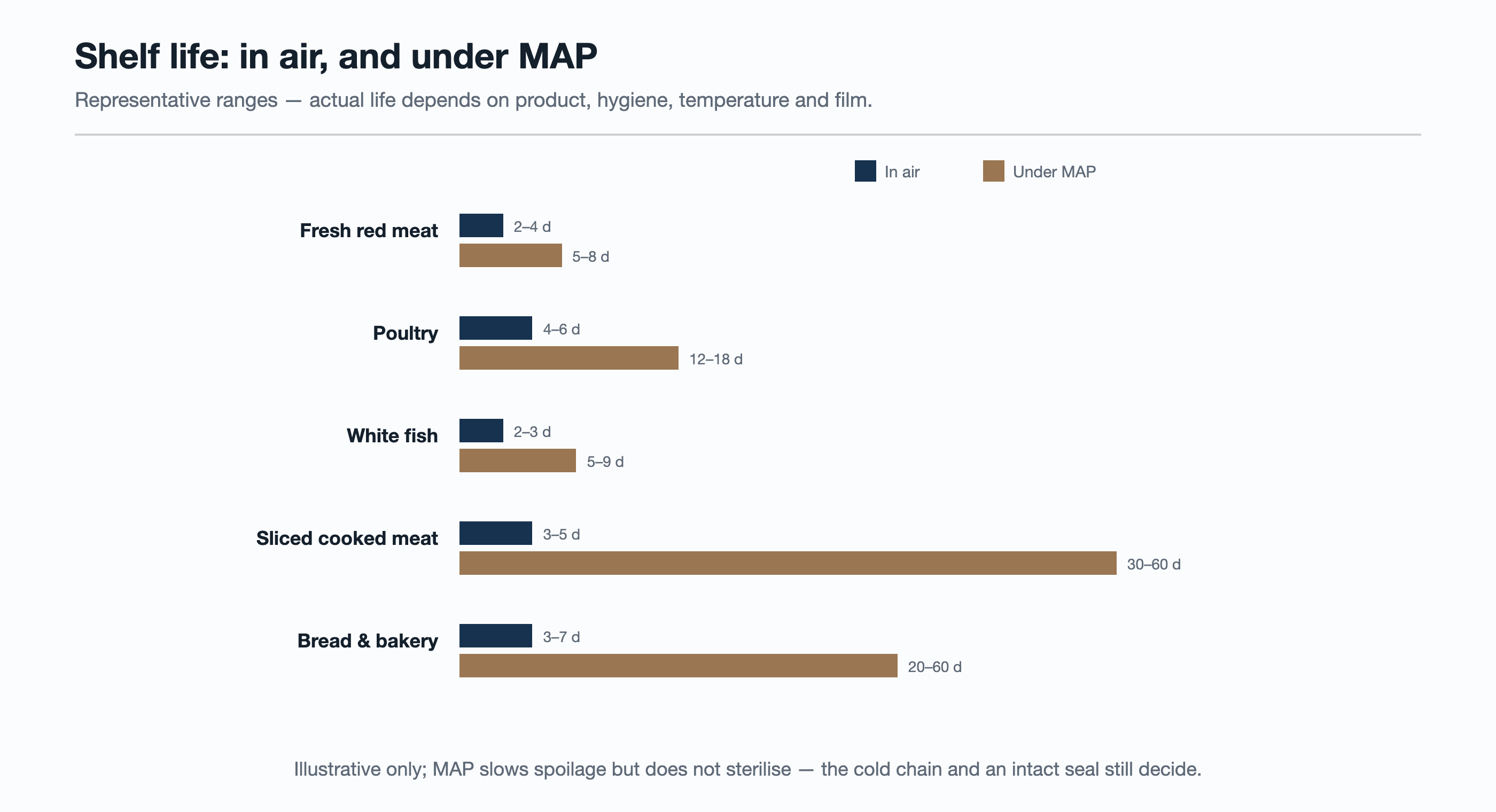
Representative shelf-life gains under MAP. Actual figures vary widely with product, hygiene, temperature and film; the values here are illustrative.
That extra time is not only a convenience for retailers. Roughly a third of all food produced is lost or wasted (FAO), and a meaningful share of the food system’s environmental footprint is carried by food that is grown, shipped and refrigerated, then thrown away regardless. An industry-commissioned literature review by McEwen Associates for the Flexible Packaging Association put a number on the U.S. share of that specifically attributable to modified atmosphere packaging: an estimated $987.9 million a year in food-waste value prevented, with produce, meat and dairy the largest categories.3 The underlying mechanism it is pointing at, gas replacing food-waste losses with a small cost in headspace, is the same one demonstrated directly in the strawberry and lamb studies above.

Industry-association estimate, not an independent audit; included as the clearest public attempt to put a number on the case.
What MAP does not do
It is worth being precise about the limits, because the same headspace argument can be misused to excuse packaging that has nothing protective about it. MAP slows spoilage; it does not sterilise. Unlike aseptic packaging, the food inside is not commercially sterile, so a broken seal or a lapse in the cold chain restarts the clock immediately. The gas mixture also has to be matched to the food: the high oxygen that flatters red meat would only accelerate spoilage in poultry or fish, and there is no universal blend. The high-barrier films that hold the atmosphere in place are frequently multilayer structures, which carries its own recyclability trade-off. MAP earns its slack-fill exemption because the gas inside is doing specific, measurable work, not because empty space is inherently defensible. A box that is mostly air with nothing to protect is still exactly the problem the regulation was written to catch.
In short
- The empty space is regulated, not incidental. FDA rule 21 CFR 100.100 treats slack-fill as misleading unless it is functional, and protecting the contents is the first listed exemption.
- Not all empty spaces are empty spaces, some are functional.
- MAP replaces the air in a pack with a gas mix tuned to the food. The film holds it; the gas does the work.
- Three gases: oxygen (colour for red meat, spoilage otherwise), carbon dioxide (the bacteriostatic preservative) and nitrogen (the inert filler that holds the pack).
- Crisps: nitrogen against rancidity. Red meat: around 45 to 80% oxygen for colour plus carbon dioxide for safety, depending on the product. Poultry, fish, cooked meats: low-oxygen mixes for longer life. Produce: equilibrium MAP tuned to the food’s own respiration.
- The payoff is shelf life and, through less food waste, an industry estimate of nearly a billion dollars a year in the U.S. alone.
References
- U.S. Food and Drug Administration, 21 CFR 100.100, “Misleading containers”: the non-functional slack-fill rule and its exemptions, including protection of the contents.
- Rodrigues, I., Trindade, M.A., Palu, A.F., Baldin, J.C., de Lima, C.G., and de Alvarenga Freire, M.T. (2018). “Modified atmosphere packaging for lamb meat: evaluation of gas composition in the extension of shelf life and consumer acceptance.” Journal of Food Science and Technology. Tested O₂/CO₂ ratios from 15/85 to 60/40, identifying 45% O₂ / 55% CO₂ as optimal for a 14-day shelf life.
- Mulla, M.F.Z., Shonte, T.T., and Pathania, S. (2025). “Quality parameters and shelf life of strawberry (cv. Centenary) fruits as affected by active modified atmosphere packaging.” International Journal of Food Science and Technology, 60(1). DOI: 10.1093/ijfood/vvaf010.
- McEwen Associates for the Flexible Packaging Association, “The Value of Flexible Packaging in Reducing Food Waste.” Industry-commissioned literature review; figures cited here are the report’s own estimates.
- FAO: global food loss and waste (approximately one third of food produced). General food-science references on the composition of air and the solubility of carbon dioxide.
Read further
- Aseptic packaging: the food is sterilised before it ever reaches the carton
- The mono-material myth: why “single material” does not mean “recyclable”
- Hemicellulose latex coatings: an excellent oxygen barrier, with one condition
This article reflects independent professional analysis and is provided for informational purposes. It is not legal, commercial or dietary advice. Gas mixtures and shelf-life figures are representative and drawn from the sources above; actual values vary with product, process and storage. Last reviewed August 2026.