
Ask whether an envelope is packaging and the question sounds as though it should have one answer. It does not. Under Regulation (EU) 2025/40, the same C5 paper envelope, from the same converter, moving through the same postal stream, can be packaging in one mailroom and not packaging in the next room along. The common misreading is that the Regulation classifies formats. It classifies functions. What settles the status of an envelope is what is inside it, and why an economic operator is sending it.
The test the Regulation applies
Article 3(1), point (1) of the PPWR defines packaging as an item, irrespective of the material it is made from, that is intended to be used by an economic operator for the containment, protection, handling, delivery or presentation of products to another economic operator or to an end user. The definition then names seven cases that are expressly included, among them an item necessary to contain, support or preserve a product without being an integral part of it; a component or ancillary element integrated into such an item; a tag hung directly on a product; service packaging filled at the point of sale; and single-serve beverage units.
Reduced to its working parts, four conditions have to hold at the same time:
- The material is irrelevant. Paper, plastic, aluminium, textile: none of it bears on the classification.
- An economic operator is the intended user. Correspondence between private individuals sits outside the frame from the start.
- The use is one of five named functions. Containment, protection, handling, delivery or presentation. Any one of them is enough.
- The object of those functions is a product. Supplied to another economic operator or to an end user, and the item is not an integral part of it.
The word carrying the weight is product. An item becomes packaging only in relation to something placed on the market. Take the product away and the definition has nothing to attach itself to. That is the envelope question in a single sentence.
Annex I is a signpost, not a gate
Annex I sets out an indicative list of items that are packaging and items that are not. Envelopes as a class appear on neither side of it. What does appear, under Article 3(1), point (1)(a), is instructive: mailing pouches for catalogues and magazines, qualified in the text itself by the words with a magazine inside. The parenthesis is doing real work. The legislator did not classify the pouch. The legislator classified the pouch in a particular condition, filled with goods. An identical pouch, empty on a stationery shelf or carrying a letter, is a different case entirely.
The Commission has been explicit about how the Annex is to be read. In its guidance document on the PPWR, issued as a Commission Notice and published in the Official Journal on 10 June 2026, it states that whether an item qualifies as packaging must be assessed against the definition in Article 3(1), point (1); that Annex I is indicative only; and that, applying the case law of the Court of Justice under Directive 94/62/EC by analogy, the inclusion of an item in Annex I is not on its own sufficient for it to be classified as packaging. Absence from the list is equally inconclusive. The list orients the reader. It does not decide.
The Commission’s own worked pair
A beverage cup sold empty to consumers in a supermarket is not packaging. The same cup, filled with coffee by that supermarket at a refill station, is packaging, and specifically service packaging. Nothing about the cup changed. What changed was the transaction it took part in. The reasoning that resolves the cup is the reasoning that resolves the envelope.
An invoice, a letter, a statement
A supplier posts an invoice in a window envelope. A bank posts an account statement. A public authority posts a tax notice. In each case the sender is acting in the course of business, the envelope contains and protects what is inside it, and the item is delivered to a named recipient. Three of the four conditions appear to be satisfied. The fourth is not.
An invoice is not a product. It is a document recording a transaction, a communication about goods or services rather than the goods themselves. Nothing is placed on the market when a statement is posted, and nothing is supplied to the recipient in the sense the definition requires. The envelope is not delivering a product; it is the physical form the correspondence takes. On the wording of Article 3(1), point (1), it falls outside the definition, and Annex I offers nothing that would pull it back in.
The practical consequence matters more than the reasoning. A bank, an insurer, a utility or a tax authority does not become a packaging producer by virtue of its correspondence volumes, however large those volumes are. That paper is waste paper. It is not packaging waste, and it does not attract extended producer responsibility obligations under the PPWR.
The line is easy to cross, and it is crossed by the contents rather than by the envelope:
- Enclose a payment card, a SIM, a cosmetic sample sachet or a promotional gift, and a product is now being delivered. The envelope contains and protects it, and the analysis reverses.
- A document pouch adhered to the outside of a parcel is a different item again. It carries no product of its own, but it is integrated into an item that is packaging, and point (1)(b) of the definition captures components and ancillary elements of exactly that kind. It follows the status of the parcel it is fixed to.
- A catalogue or a magazine inside a mailing pouch is the case Annex I already answers. It is packaging.
A shirt in a paper mailing bag
Now take an online retailer that packs a cotton shirt into a paper mailing bag and posts it to a consumer. Every element of the definition is satisfied without strain. The retailer is an economic operator. The bag contains the shirt, protects it in transit and delivers it. The shirt is a product supplied to an end user. The bag is not an integral part of the shirt: the consumer opens it, takes the shirt out and discards it.
The bag is packaging. More precisely it is transport packaging, and because the sale is concluded at a distance, it is e-commerce packaging, a sub-category that carries obligations of its own. None of that turns on the bag being paper. Substitute a poly mailer or a padded envelope and the classification is identical, although the recyclability assessment, the material identification and the fee consequences will not be.
Set the two cases side by side and the asymmetry is stark. The letter and the mailing bag may weigh within a few grams of each other, may be made by the same mill from the same furnish, and may be handled by the same postal operator on the same round. One sits entirely outside the Regulation. The other sits inside it, and inside a phased programme of design, documentation and fee obligations running to 2038.
One item, three positions
- A box of one hundred envelopes sold to a consumer in a stationery shop. The envelopes are the product. The box around them is the packaging.
- A pallet of mailing bags sold empty by a converter to an online retailer. The bags are transport packaging placed on the market empty, and the operator who first makes them available in a Member State is the producer for extended producer responsibility purposes.
- A mailing bag with a shirt inside, delivered to a consumer. E-commerce packaging, and the retailer’s design decisions are what the sustainability requirements bite on.
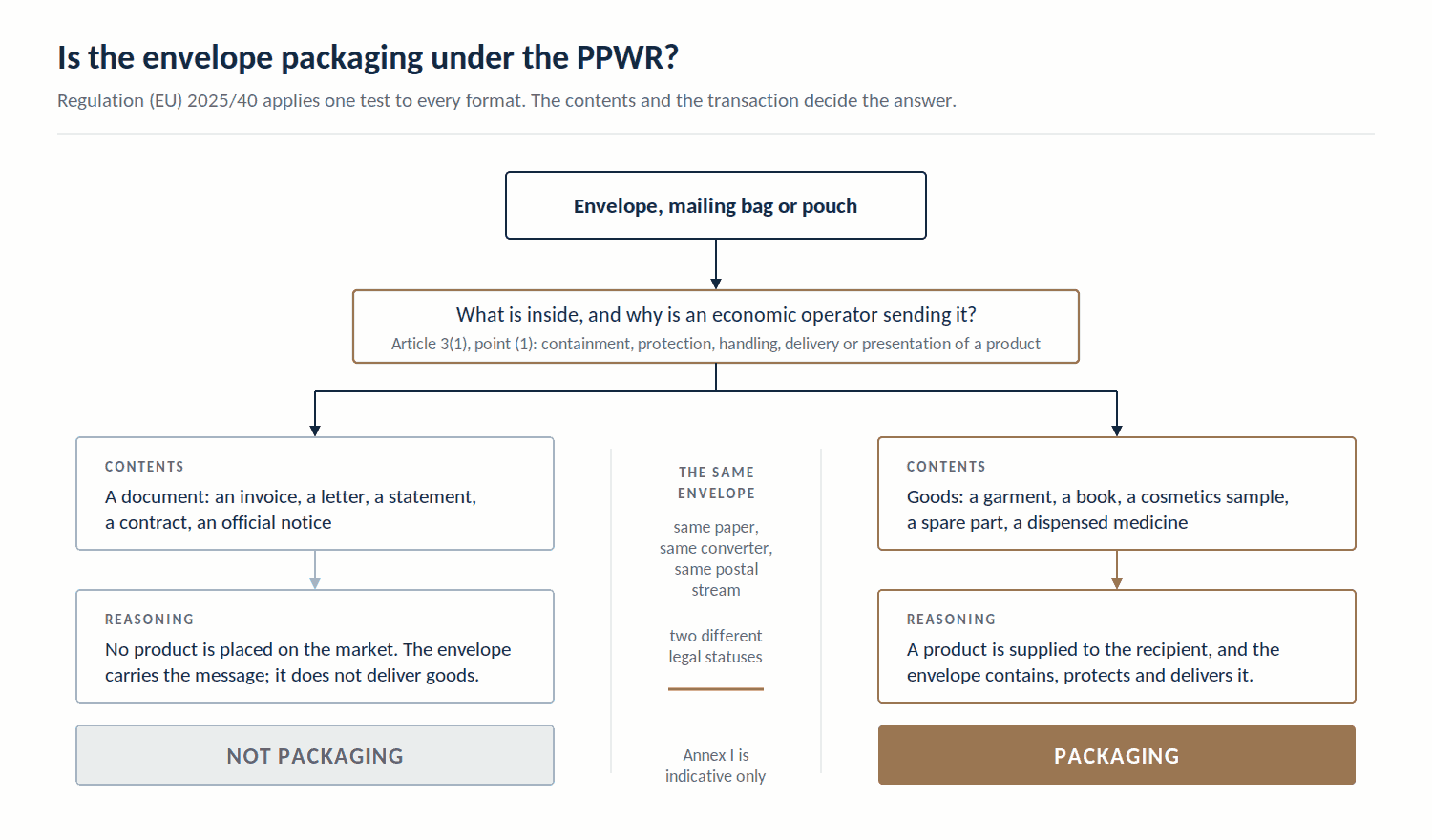
Classification under Article 3(1), point (1) of Regulation (EU) 2025/40. Annex I is indicative and does not displace the definition.
What turns on the answer
The distinction is not academic. From 12 August 2026, packaging placed on the Union market has to conform to the sustainability and labelling requirements in Articles 5 to 12, supported by technical documentation under Annex VII and an EU declaration of conformity. Further obligations phase in behind that date: harmonised labelling from August 2028, recyclability performance grading and recycled content rules from 2030, minimisation requirements, and an empty space ceiling for grouped, transport and e-commerce packaging.
Extended producer responsibility runs on a separate track, with its own test of who is liable. A producer registers and contributes in the Member State where the packaging is expected to become waste. For sales packaging that is normally the operator who first makes the packaged product available there. For transport and service packaging supplied empty, the Regulation places the responsibility on the manufacturer, importer or distributor who first makes the empty packaging available on that territory, which is why mailing bags are usually accounted for by the supplier rather than by the retailer who fills them.
Errors therefore run in both directions. Treat correspondence as packaging and a business pays fees on tonnage that never belonged in the scheme, and files declarations for items that were never in scope. Treat e-commerce mailers as ordinary stationery and it under-reports, leaves design decisions unexamined, and arrives at 2030 with a portfolio it has never assessed.
Is this a universal rule?
The reasoning holds on the text, but it does not dispose of every envelope, and a compliance file should record where the residual questions lie.
- Annex I is indicative and can be amended. The Commission has stated that the guidance document and the accompanying frequently asked questions may be updated as practical experience accumulates, and the FAQ document has already been reissued.
- Mixed consignments are common. A letter accompanied by a small product sample is one item to the postal operator and two questions to a compliance team.
- Prepaid returns envelopes enclosed with an order are supplied by an economic operator and are intended to carry a product back through the chain. They sit close to the line and deserve a documented position rather than an assumption.
- Enforcement is national. Market surveillance authorities and scheme operators will apply the definition through their own catalogues and established practice, and divergence at the margins is likely before it is resolved.
One further caution is worth stating plainly. Classification under Article 3(1) is a legal categorisation and nothing more. It determines which rules apply. It says nothing about whether a given envelope is recyclable, well designed or environmentally preferable, in the same way that the composite packaging definition draws a boundary for categorisation rather than delivering a verdict on recyclability.
A working test
For a mailroom, a fulfilment centre or a compliance file, five questions settle most cases.
- Is an economic operator sending this, in the course of its business?
- Is there something inside that is a product placed on the market, as distinct from a document about a product?
- Does the envelope contain, protect, handle, deliver or present that product?
- Is the envelope separate from the product, discarded once the product is taken out?
- If the answers are yes, is it sales, grouped, transport or e-commerce packaging, and who is the producer in each Member State of supply?
Work through those and the format stops mattering, which is the point. The PPWR does not ask what an envelope is. It asks what an envelope is doing.
References
- Regulation (EU) 2025/40 of the European Parliament and of the Council of 19 December 2024 on packaging and packaging waste, amending Regulation (EU) 2019/1020 and Directive (EU) 2019/904, and repealing Directive 94/62/EC, in particular Article 3(1), points (1), (13) and (15), Articles 5 to 12, Annex I and Annex VII. EUR-Lex
- European Commission, Commission Notice, Guidance document for Regulation (EU) 2025/40 on packaging and packaging waste, C/2026/3084, OJ C, 10 June 2026, section 1 on the definition of packaging. EUR-Lex
- European Commission, Directorate-General for Environment, Packaging and Packaging Waste Regulation (PPWR): Frequently Asked Questions, first published 30 March 2026 and since reissued. European Commission
- Commission Directive 2013/2/EU of 7 February 2013 amending Annex I to Directive 94/62/EC, for the earlier illustrative list from which several Annex I entries are carried over. EUR-Lex
Read further
- Composite packaging under the PPWR: a legal boundary, not a scientific one
- Material identification codes: what they mean, what they do not, and how the PPWR changes them
- The mono-material myth: why “single material” does not mean “recyclable”
This article reflects independent professional analysis and is provided for informational purposes. It does not constitute legal advice or an official position of any organisation. Worked examples are illustrative; the classification of a specific consignment depends on its actual contents and the transaction in which it is sent. Readers should work from the text of Regulation (EU) 2025/40 and take their own advice. Last reviewed August 2026.