
We tend to treat packaging as a modern problem: a consequence of supermarkets, global supply chains and consumer convenience. It is worth testing that assumption. Two thousand years ago the Roman world had standardised containers of uniform volume, inert food-contact surfaces, branded vessels carrying their maker’s name, and an established trade in recycled material. The technology was different. The functions were not.
What packaging is for
Before looking backwards, it is worth stating what packaging actually does. Strip away the material and the era, and the functions are remarkably stable:
- Containment: holding a defined quantity of something that would otherwise disperse.
- Protection: shielding contents from impact, light, moisture, oxygen and contamination.
- Preservation: extending usable life by controlling what reaches the product.
- Transport and handling: making goods stackable, liftable and shippable.
- Portioning: dividing bulk into units a buyer can purchase and use.
- Expression: carrying aesthetic, cultural or symbolic meaning.
Every one of those functions is visible in the Roman material record. The last two are the ones we most often assume to be modern inventions, and they are the ones the archaeology contradicts most directly.
Glass before breath
Glass had existed for millennia before Rome, but it was not a material for containers in any everyday sense. Vessels were core-formed, cast, ground or cut: slow, skilled, wasteful processes that produced small numbers of thick-walled, often opaque objects. Late Republican and early Imperial glassware took its shapes from luxury metal tableware, imitating lathe-cut and punched designs. Glass was a prestige material, and its cost placed it near the top of the household.
This is the ordinary condition of most materials for most of history: technically possible, economically marginal. What changes that condition is rarely the discovery of the material. It is the discovery of a process.
The breakthrough
Somewhere on the Syro-Palestinian coast, in the first century BC, glassworkers discovered that molten glass could be inflated at the end of a hollow tube. Pliny records flatu figurare (shaping by breath) as one of the techniques that made Sidon famous.
The earliest evidence, from the environs of Jerusalem, is unglamorous and rather wonderful: furnace workers reheating the ends of glass tubes to rework them, in what has been interpreted as experimentation with recycling scrap. Somebody, at some point, blew down one of those tubes. There is no named inventor, and the honest formulation is that the technique emerged in the eastern Mediterranean in the first century BC rather than being invented by any one person on any one day.
Why it mattered
Blowing used less raw material, took less labour and less time, and allowed thin walls and an enormous range of forms. A glass container could now be made quickly and cheaply. The timing helped: the technique spread as Augustus established the Pax Romana, and skilled craftsmen moved from the eastern provinces into Italy along newly secure trade routes. A material that had been the preserve of the wealthy became, within a couple of generations, ordinary.
The mould: repeatability as an invention
Free-blowing made glass cheap. Mould-blowing, developed shortly afterwards as an offshoot, made it repeatable, and that is the step with the greater consequence for packaging.
A craftsman cut a mould, usually in baked clay, sometimes wood or metal, in at least two parts so the finished vessel could be released. Designs were carved in negative, appearing in relief on the glass. The glassblower inflated a gob of hot glass into the mould, removed it, then finished the rim and added handles while the glass was still workable. The mould was reassembled and used again.
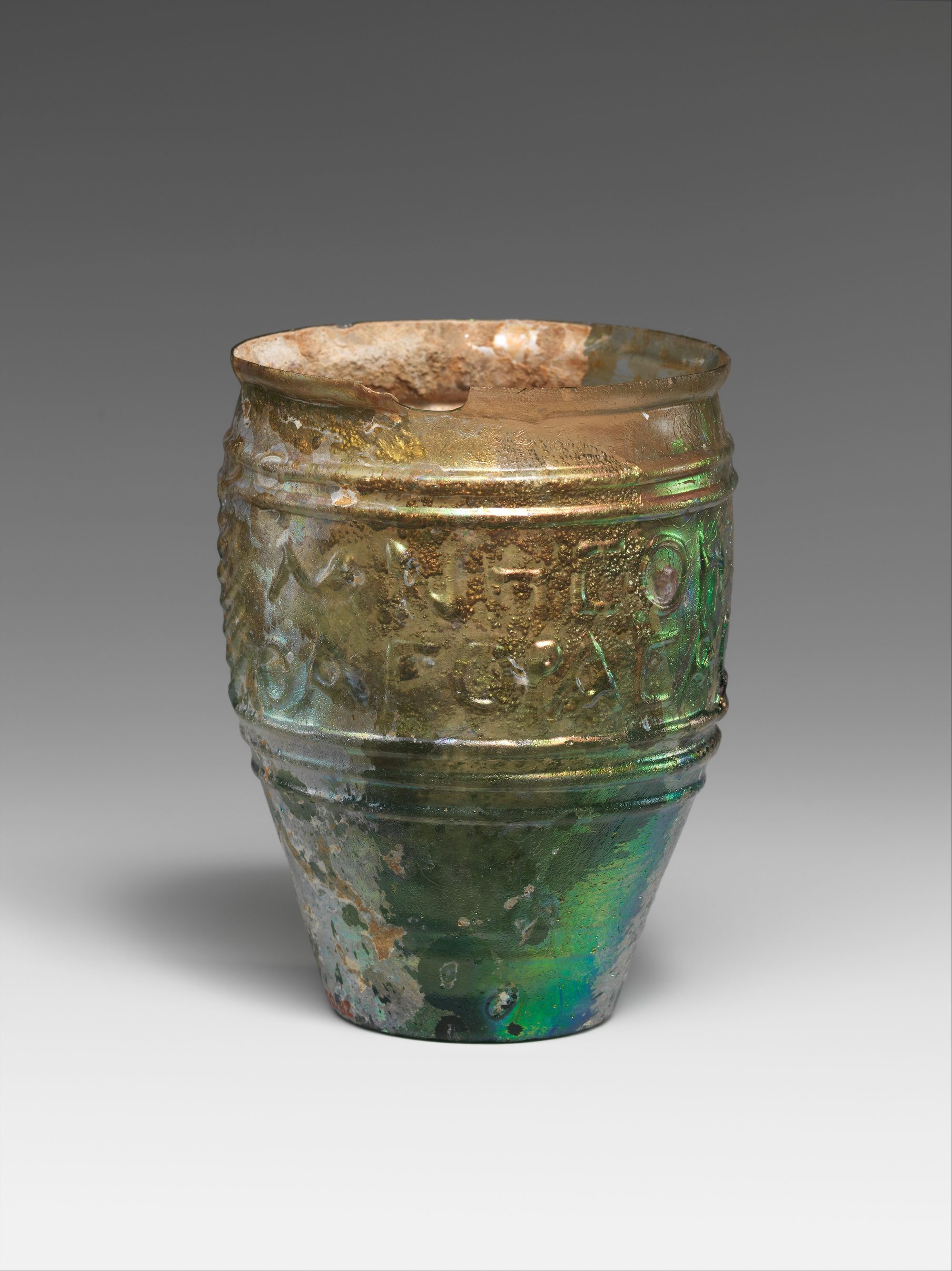
There is a detail here that any manufacturing engineer will recognise. Moulds wore out. A replacement could be cut fresh, or taken as a copy from an existing glass vessel, and because both clay and glass shrink on firing and annealing, each successive generation produced slightly smaller vessels. Second, third and fourth-generation moulds can be traced in surviving objects, along with small modifications introduced by recarving. This is tooling drift, documented in the archaeological record two thousand years before statistical process control.
The packaging argument
Mould-blowing is usually discussed for its decorative results: sports cups commemorating gladiatorial games, bottles shaped as fish or bunches of grapes, vessels of real sculptural ambition. Those objects are the reason the technique appears in art-historical surveys.
But the same technique also permitted mass production of plain utilitarian ware. The Metropolitan Museum makes the point directly: mould-blown storage jars were of uniform size, shape and volume, which greatly benefited merchants and consumers of foodstuffs and other goods routinely marketed in glass containers.
Read that again
Goods were routinely marketed in glass containers of standardised volume. That is not a container in the general sense. That is packaging: a defined unit of sale, of consistent capacity, produced at scale, in a material chosen for its performance.
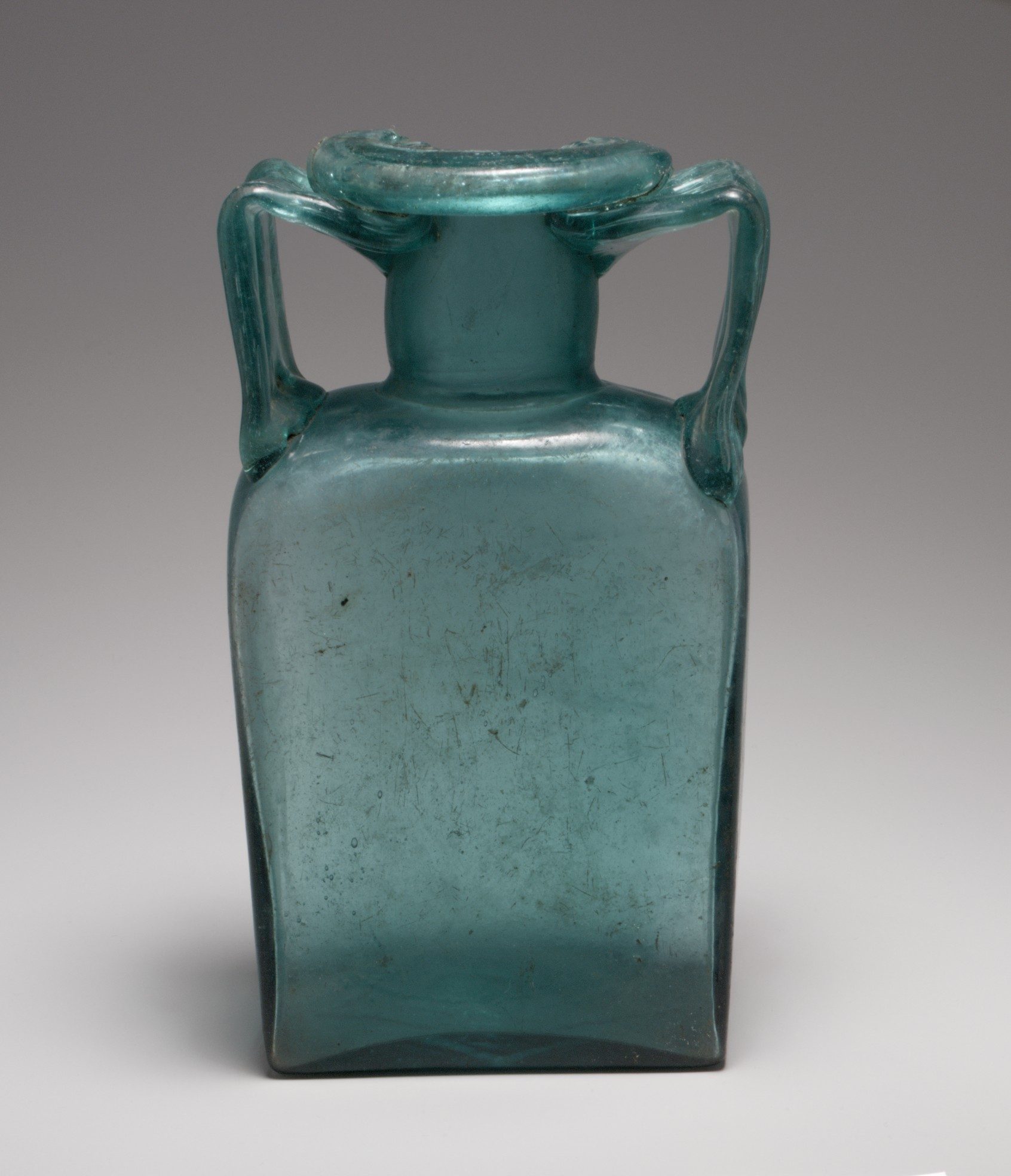
The choice of material was functional and would be defended in the same terms today. Glass is inert: it does not affect the taste of what it holds, which allowed longer storage. Most ancient pottery was unglazed and seeped; metals affected flavour. Glass is also non-porous and odourless, which is why perfume, oil and cosmetic containers (unguentaria and balsamaria) were made from it in enormous numbers. Transparency, meanwhile, let a buyer see the contents.
Cheap standardised vessels also changed how people bought. Consumers could have glass containers filled at shops and taverns, purchasing smaller quantities at a time. Portioning, refill and unit pricing are not twentieth-century retail concepts.
Ennion, or branding in the first century
The most striking evidence sits on the objects themselves. A Greek-speaking Syrian glassmaker named Ennion, working in the first half of the first century AD, carved his name into his moulds. Surviving vessels carry the inscription Ennion made me, in relief, as part of the vessel wall.
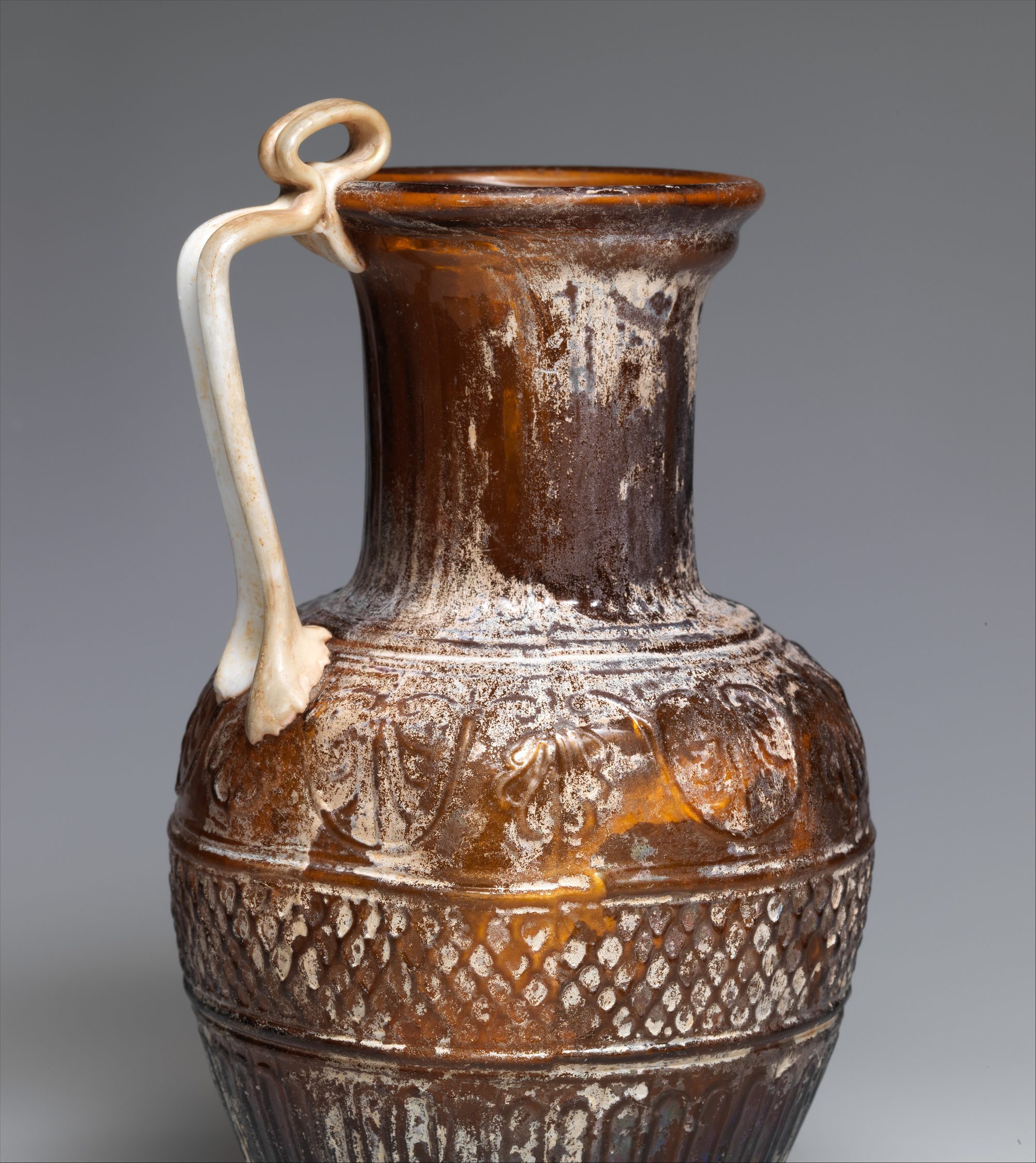
Consider what that required. A repeatable production process. A maker confident enough in consistent quality to attach his identity to every unit. A market in which buyers could recognise a name and might pay for it. And a decorative programme reproduced identically across a production run.
Blowing did not merely make glass cheaper. It made maker identity and market branding possible on a mass-produced container. The signature is moulded into the packaging itself, which is precisely where we still put it.
And the material was recycled
Glassblowers could remelt their offcuts and broken fragments directly. Roman writers of the Flavian period (Martial, Juvenal, Statius) refer to the trade in broken glass, and the earliest experiments that led to blowing may themselves have been attempts at reworking scrap. A cullet trade existed because remelting glass is easier than making it from raw materials, which remains the economic logic of glass recycling now.
So the Roman glass container was standardised, inert, food-safe by virtue of its chemistry, branded, refillable and recyclable. The vocabulary is modern. The practice is ancient.
What this carries for us
Process innovation democratises materials, not material discovery. Glass was thousands of years old when blowing made it ordinary. The lesson transfers directly: the constraint on most sustainable packaging materials today is not whether the material exists, but whether it can be converted at cost, at speed and at consistent quality.
Standardisation is what turns a container into packaging. Uniform volume is what makes trade, pricing and comparison possible. Much modern packaging regulation (harmonised labelling, defined recyclability grades, standard test methods) is doing the same work in a different register: making things comparable.
Inertness has always been the food-contact requirement. The Roman preference for glass over unglazed pottery and metal was a judgement about interaction between package and product. That is still the central question in food-contact legislation, now expressed through migration limits and compliance testing.
Recycling follows economics, not sentiment. Cullet was collected because remelting was cheaper than melting raw batch. Where recycling systems work today, the same is usually true; where they fail, it usually is not.
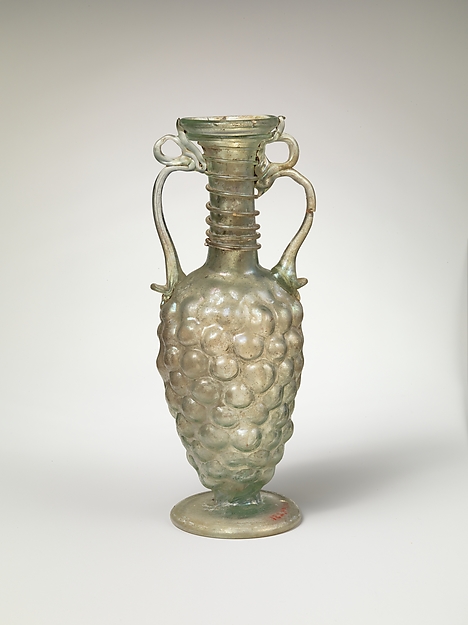
Packaging has always carried meaning. A fish-shaped bottle, a souvenir cup from the games, a signed jug: these are not aberrations from the functional purpose of packaging. Expression sits alongside containment and protection in the list of things packaging does, and it always has.
The notion that packaging is a modern invention is comfortable, because it implies it could be uninvented. The Roman evidence suggests otherwise. What is genuinely modern is the scale, the material mix, and the fact that we now have to account for what happens after the container is empty. That is a real and difficult problem. It is not the same as the problem of packaging itself, which humans appear to have solved, and re-solved, for a very long time.
Sources
- Trentinella, R. “Roman Mold-Blown Glass.” Heilbrunn Timeline of Art History, The Metropolitan Museum of Art. metmuseum.org
- “An Introduction to the History and Technology of Ancient Glass Production.” Ancient Glass in the J. Paul Getty Museum. getty.edu
- “Ennion and His Legacy: Mold-Blown Glass from Ancient Rome.” Corning Museum of Glass. cmog.org
- “How the invention of glassblowing changed everyday life in ancient Rome.” The Conversation. theconversation.com
- Stern, E. M. Roman Mold-Blown Glass: The First through Sixth Centuries. Rome, 1995.
- Price, J. “Decorated Mould-Blown Glass Tablewares in the First Century AD.” In Roman Glass: Two Centuries of Art and Invention, eds. Newby & Painter, pp. 56–75. London, 1991.
Images. Photographs of objects in the collection of The Metropolitan Museum of Art, New York, reproduced under the Museum’s Open Access policy, which makes images of public-domain works available under a Creative Commons Zero (CC0) licence.
Related reading
This essay reflects independent professional analysis and is provided for informational purposes. Dating and attribution in ancient glass studies remain subject to scholarly debate; where the evidence is uneven, that is noted in the text. Last reviewed July 2026.