
Bark arrives at every sawmill and pulp mill in enormous quantity. It is also, chemically, an unusually good candidate for replacing petrochemical polyols in polyurethane. The gap between those two statements is not about availability or cost. It is about one structural feature of bark chemistry.
What a polyol has to do
Polyurethane is formed by reacting a polyol, a molecule carrying multiple hydroxyl (OH) groups, with a polyisocyanate. The OH groups react with isocyanate groups to form urethane linkages, building the polymer network. In a rigid foam, that network must set quickly, trap the blowing gas in closed cells, and hold a stiff, low-density structure.
The polyol therefore determines much of the outcome: how many OH groups it carries, how they are spaced, how rigid the backbone between them is, and (critically for processing) how viscous the liquid is.
Why bark is a candidate
Bark contains cellulose, hemicellulose, lignin and tannins: all highly functionalised materials rich in hydroxyl groups, which is precisely what makes them promising for bio-based polyols. It requires no synthesis to introduce OH functionality, because the functionality is already there.
Two bark fractions matter most. Condensed tannins are phenolic polymers concentrated in bark, carrying multiple aromatic hydroxyls. Suberin, abundant in birch bark, is a polyester of long-chain fatty acids and can be depolymerised into suberinic acids.
The problem: the OH groups are on the wrong backbone
This is the single issue that governs the field. A phenolic hydroxyl sits directly on an aromatic ring. Two consequences follow, and both are unhelpful.
Reactivity. Phenolic OH is less reactive towards isocyanate than an aliphatic OH, and sterically crowded on a bulky ring.
Rigidity and viscosity. Aromatic rings are stiff, and tannin molecules associate strongly with one another. The practical result is that tannins’ insolubility in appropriate solvents and their high viscosity are the key barriers when they are used in polyurethane systems. A polyol that will not flow cannot be metered, mixed or foamed on production equipment.
The consequence in the foam
Where unmodified bark material is simply added, the foams tend towards higher density and brittleness, and the cellular structure becomes increasingly deformed at higher substitution levels. The chemistry works; the material does not. Rigid foam depends on a regular closed-cell structure, and an aromatic-rich, poorly dispersed polyol disrupts exactly that.
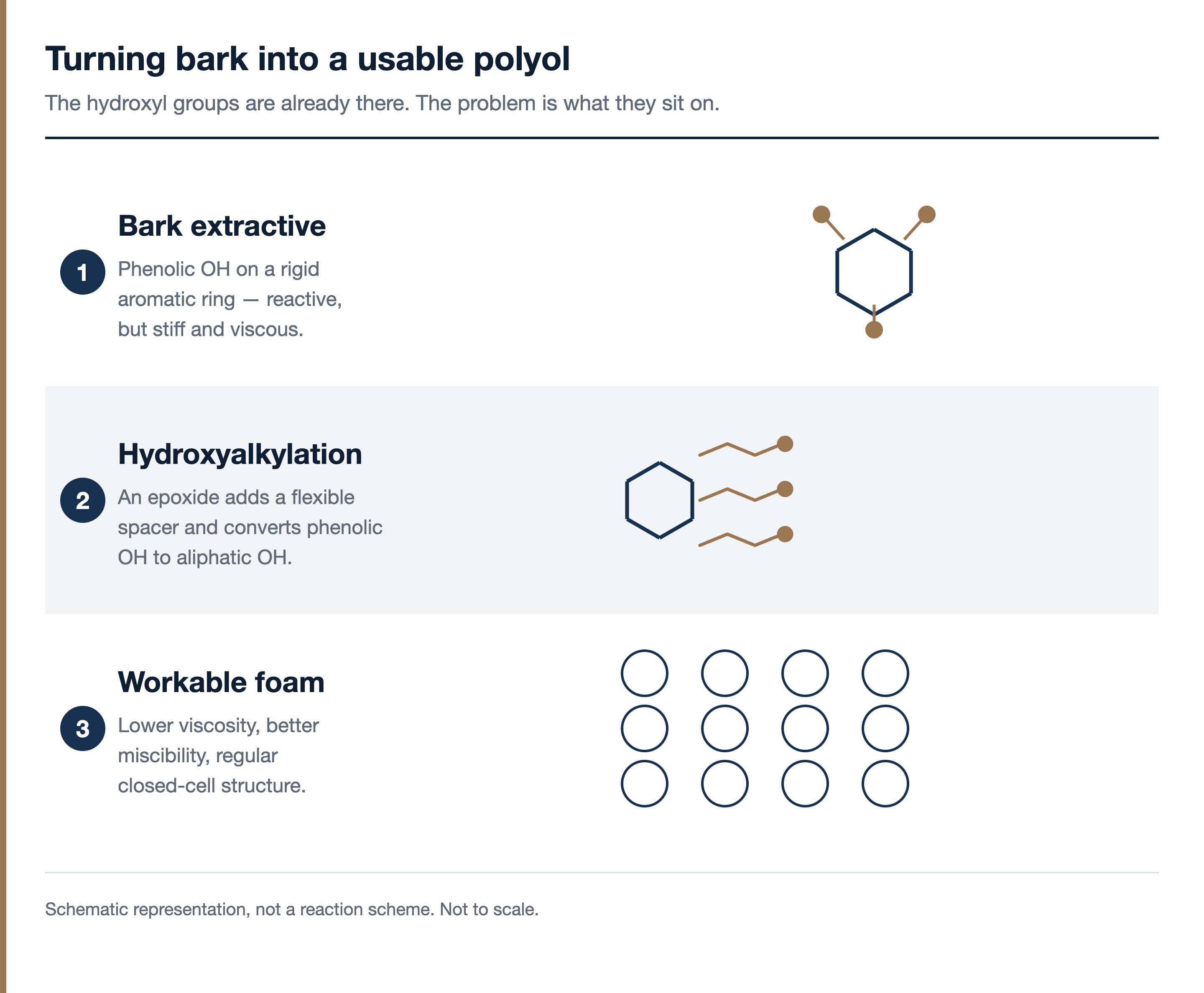
The solution: move the hydroxyl off the ring
Nearly every successful route does the same thing. It reacts the phenolic hydroxyls with an epoxide, converting them into aliphatic alcohols and, in the process, inserting a short flexible chain between the ring and the OH group.
This achieves three things at once. The hydroxyl becomes more reactive. The molecule gains internal flexibility. And viscosity falls, because the added chains reduce the association between aromatic units. Work on Pinus radiata bark tannin used butylene oxide in a mild-base, solvent-free reaction to produce hydroxybutylated tannin with viscosities suitable for foam production.
Other chemistries follow the same logic. Pine bark extractives condensed with propylene carbonate produced bio-polyols which, at an optimised ratio, gave foams with compressive strength and thermal insulation exceeding the reference material by 30 per cent and 9 per cent respectively, with improved thermo-oxidative stability.
Or choose a fraction that is already flexible
The alternative is to avoid the aromatic problem rather than fix it, by selecting bark components that are not aromatic in the first place.
Suberin is the clearest case. Foams built on polyols from depolymerised birch bark suberin together with tall oil fatty acids reached 74 per cent renewable content, with apparent density around 40–44 kg/m³, closed cell content around 95 per cent, compressive strength above 0.2 MPa and thermal conductivity around 0.019 W/(m·K), competitive with petroleum-based equivalents. Those are commercially meaningful numbers, not laboratory curiosities.
Diarylheptanoids from black alder bark make the structural argument explicitly. Unlike tannins, which are aromatic and cyclic, these molecules carry C7 aliphatic linear chains that can act as natural soft segments in the polyurethane network, providing a favourable balance between rigidity and flexibility.
The pattern
Read across the literature and one principle emerges. Success correlates with the presence of aliphatic chain segments: whether native, as in suberin and diarylheptanoids, or grafted on, as in hydroxyalkylated tannins. Bark’s aromatic content is what makes it abundant and cheap; its aliphatic content is what makes it usable.
A distinction worth keeping
Bark can enter a foam two ways, and they are not equivalent. As a reactive polyol, it is chemically built into the network. As a filler, it is dispersed but not bonded.
The difference shows in performance. Incorporating extracted bark as a filler at up to 10 wt% reduced mechanical properties to the level of the reference foam and cut thermal insulation capacity by 19 per cent. Filler raises renewable content on paper while degrading the property that rigid foam exists to deliver.
Where this leaves it
The technical position is more advanced than the commercial one. Foams meeting insulation-grade specifications from bark-derived polyols have been demonstrated repeatedly.
What remains difficult is consistency. Bark composition varies by species, growing conditions, season and the process that removed it. A petrochemical polyol arrives with a hydroxyl number and viscosity guaranteed to a narrow tolerance; a bark extract does not. Every modification step also adds cost and reagent input to a feedstock whose appeal was that it was cheap and available.
That is the real barrier: not whether bark can make good foam, but whether it can make the same foam twice.
References
- Rigid polyurethane foams’ development and optimization from polyols based on depolymerized suberin and tall oil fatty acids. PMC
- Preparation and physicochemical characterisation of polyurethane foams prepared using hydroxybutylated condensed tannins as a polyol source. Industrial Crops and Products. ScienceDirect
- Impact of bark-sourced building blocks as substitutes for fossil-derived polyols on the structural, thermal and mechanical properties of polyurethane networks. PMC
- Pine bark as a lignocellulosic resource for polyurethane production: an evaluation. PMC
- Bio-based polyurethane resins derived from tannin: source, synthesis, characterisation and application. Forests 12(11), 1516.
Related reading
This article reflects independent professional analysis and is provided for informational purposes. Reported values are specific to the formulations and feedstocks in the cited studies and should not be read as general performance figures. Last reviewed July 2026.