
Total fluorine has become the practical entry point for PFAS screening, because measuring thousands of substances individually is impossible and measuring one element is straightforward. It is a reasonable proxy. It is also, read carelessly, a source of false positives, because a great deal of fluorine in the world has nothing to do with PFAS.
What total fluorine measures
Total fluorine (TF) is an elemental measurement. It quantifies every fluorine atom in a sample, irrespective of what molecule it belongs to.
The usual technique is combustion ion chromatography (CIC). The sample is thermally oxidised at 900–1100°C in an oxygen and argon flow, which converts organic fluorine to hydrogen fluoride. The acidic combustion gases are collected in water, and the resulting fluoride is separated on an ion-exchange column and detected by conductivity. Alternatives include particle-induced gamma-ray emission (PIGE), instrumental neutron activation analysis and combustion with a fluoride ion-selective electrode.
The attraction is obvious. It is fast, comparatively inexpensive, requires no analytical standard for each substance, and it captures unknown PFAS as readily as known ones.
The answer to the direct question
No. Combustion ion chromatography cannot differentiate between organic and inorganic fluorine. The combustion step converts everything to fluoride, and fluoride from a mineral filler is indistinguishable from fluoride derived from a fluoropolymer. Any selectivity in the result comes entirely from how the sample was prepared before combustion, not from the measurement itself.
The parameters, and what separates them
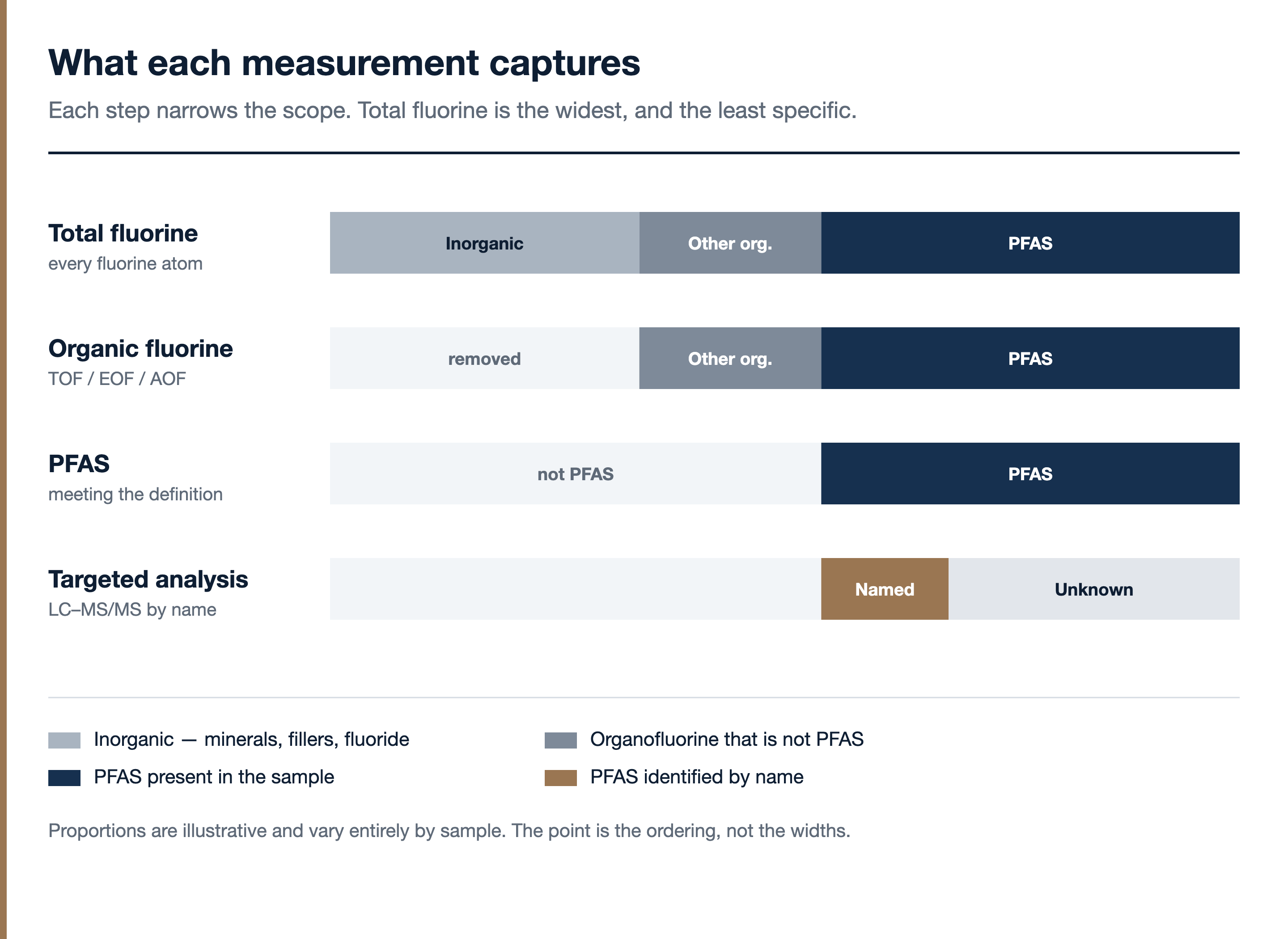
Because the instrument is indiscriminate, the discipline lies in sample preparation. That is what distinguishes the acronyms.
| Parameter | What it is |
|---|---|
| TF: total fluorine | Everything. Direct combustion, no pre-treatment. |
| TIF: total inorganic fluorine | Water extraction followed by direct ion chromatography. |
| TOF: total organic fluorine | Usually calculated indirectly, as TF minus TIF. |
| EOF: extractable organic fluorine | Solvent extraction, typically methanol–acetonitrile, then combustion. |
| AOF: adsorbable organic fluorine | For water. Organics adsorbed on a sorbent, inorganic fluoride washed away. |
| Targeted analysis | LC–MS/MS identifying named substances against reference standards. |
Where inorganic fluorine comes from
Fluorine is the thirteenth most abundant element in the Earth’s crust. Inorganic fluoride is therefore not a contaminant in the usual sense: it is a normal constituent of geological and biological materials.
Minerals. Fluorite (calcium fluoride), cryolite and fluorapatite are the principal fluorine-bearing minerals. Fluorapatite occurs in phosphate rock, which means fluoride travels with phosphate through many industrial chains.
Water. Groundwater carries dissolved fluoride from the rock it passes through, at concentrations that vary widely by geology. Some public supplies are additionally fluoridated.
Mineral fillers and pigments. This is the one that matters most for paper and board. Fillers and coating pigments are mineral products, and mineral products may carry trace fluoride. Recent work on indirect TOF determination was tested specifically against mineral fillers used in paper manufacturing, which tells you where the problem was found.
Recycled fibre, soil, dust and process water all contribute at trace level, and none of it indicates that anything was intentionally added.
A second false positive, less often mentioned
Removing inorganic fluorine leaves organic fluorine, but organic fluorine is not the same as PFAS.
Many pharmaceuticals and agrochemicals contain carbon–fluorine bonds without meeting the PFAS definition, which requires a fully fluorinated –CF₃ or –CF₂– carbon. A single fluorine substituent on an aromatic ring is organofluorine and is not PFAS. So even a clean TOF or EOF result overstates PFAS content to some degree.
The gap in the other direction
It would be wrong to present total fluorine as merely over-inclusive, because targeted analysis is badly under-inclusive.
LC–MS/MS has been reported to monitor only up to around 73 different PFAS, limited by the availability of reference standards and by whether a substance ionises at all. High-resolution mass spectrometry can reach over 750, but is prone to false positives and false negatives and has high detection limits. Against a group of roughly 10,000 substances, both leave a large unmeasured remainder.
This is why fluorine mass balance has become standard practice: comparing EOF against the sum of targeted results reveals the unknown organofluorine fraction. Total fluorine methods exist precisely because named-substance analysis cannot see most of what is there.
How reliable is it in practice?
Less than the apparent precision of a number in mg/kg suggests, and the weak point is exactly where you would expect.
An inter-laboratory comparison found substantial discrepancies in TOF results (particularly for paper-based material) while TF measurements were comparatively consistent across laboratories. Comparison of the standards and in-house methods used indicated that the pre-treatment step, rather than combustion or fluoride detection, was the primary factor influencing TOF values.
The specific failure mode is instructive. Aqueous extraction, used to remove inorganic fluorine before calculating TOF, often overestimates TOF, because water does not fully extract inorganic fluorides. Under-removal of the inorganic fraction inflates the organic result: the false positive arises during the very step intended to prevent it. Work in this area has proposed a pre-combustion stage at 525°C to address it.
The practical consequence
A high total fluorine result is a signal to investigate, not a finding of PFAS. A high TOF result derived by subtraction is a signal to check the pre-treatment before it is a finding of anything. The published inter-laboratory work indicates that the lack of standardised procedures raises real concerns about reliability, particularly where inorganic fluorine is present and could be mistakenly interpreted as indicative of PFAS.
Why regulators use it anyway
Because the alternative is unenforceable. An authority cannot require a laboratory to demonstrate the absence of ten thousand substances individually.
Total fluorine and total organic fluorine thresholds are therefore increasingly used as proxies to control PFAS in packaging. Denmark’s 2020 restriction on PFAS in paper and board food contact materials introduced an indicator threshold of 20 µg organic fluorine per gram to help industry assess intentional addition. The EU restriction proposal takes a comparable approach, using a total fluorine trigger above which an operator may be required to demonstrate whether the fluorine measured is PFAS or not.
Note the construction: the threshold does not establish a violation. It shifts the burden of explanation. Read that way, total fluorine is being used correctly: as a screen, not as a verdict.
Practical guidance
State the parameter, not just the number. TF, TIF, TOF, EOF and AOF are not interchangeable, and a result reported as “fluorine” without specifying which is uninterpretable.
Ask how inorganic fluorine was removed. For an indirect TOF this is the dominant source of variability, and the answer determines whether the figure means anything.
Know your mineral inputs. For fibre-based packaging, fillers and pigments are the most likely explanation for an unexpected total fluorine result. That is a defensible answer to an enforcement query, provided it can be evidenced.
Treat exceedance as a question. Total fluorine above a threshold means fluorine is present. Establishing what kind requires a further step, and that step is where the actual finding is made.
References
- Assessing reliable measurements of total organic fluorine in food packaging materials. Food Additives & Contaminants: Part A, 43(4). doi:10.1080/19440049.2026.2623139
- Comprehensive screening of PFAS in food contact materials: utilizing combustion ion chromatography for total organic fluorine analysis. Journal of AOAC International, 108(3), 367. Oxford Academic
- A systematic review of methods for the analysis of total PFAS. Science of the Total Environment. ScienceDirect
- Analysis of PFAS in raw materials intended for paper-based food contact materials — evaluating LC-MS/MS versus total fluorine and extractable organic fluorine. Taylor & Francis
- Ion selective electrode method for determination of total fluorine and total organic fluorine in packaging substrates. PMC
- Nordic Council of Ministers, Analysis of needs for enforcement of PFAS in articles and chemical products (TemaNord 2024:510). norden.org
Related reading
This article reflects independent professional analysis and is provided for informational purposes. It does not constitute legal or analytical advice. Method performance, detection limits and regulatory thresholds vary by jurisdiction, matrix and laboratory; readers should work from the applicable standard and consult their testing laboratory. Last reviewed July 2026.