
PFAS is one of the few chemical terms that has entered general use while becoming less clearly understood. It is not a substance, nor a class of similar substances. It is a structural definition that captures many thousands of chemicals with very different properties, uses and behaviour, united by a single bond arrangement.
What the term actually covers
PFAS stands for per- and polyfluoroalkyl substances. Under the OECD definition published in 2021 (the definition used in the EU restriction proposal), a PFAS is any substance containing at least one fully fluorinated methyl (–CF₃) or methylene (–CF₂–) carbon atom, with no hydrogen, chlorine, bromine or iodine attached to that carbon.
Two things follow from this, and both matter. The definition is structural: it describes an arrangement of atoms, and says nothing about toxicity, mobility, persistence in a given medium, or function. And it is broad: a single fully fluorinated carbon anywhere in a molecule is sufficient.
Why the carbon–fluorine bond matters
Everything useful and everything problematic about PFAS traces back to one bond. The carbon–fluorine bond is the strongest single bond in organic chemistry. Fluorine is the most electronegative element and small enough to pack tightly around a carbon backbone, forming a dense electron shield that protects the chain beneath it.
The practical consequences are a set of properties that are difficult to obtain together by any other route: thermal stability at temperatures that destroy most organics; chemical inertness towards acids, bases, solvents and oxidising agents; very low surface energy; low friction; and electrical insulation.
One property deserves separate mention because it is close to unique. Fluorinated surfaces repel both water and oil. Waxes and silicones repel water; almost nothing repels water and oil simultaneously while also surviving heat and abrasion. Where a specification requires both, the field of alternatives narrows sharply.
How many substances
Counts vary with the definition and the database, which also makes them difficult to measure, as discussed in this article on total fluorine screening. The OECD had identified more than 4,700 PFAS by CAS number in its 2018 inventory. Sweden’s regulatory database lists almost 11,000 substances meeting the 2021 OECD definition. The EU restriction proposal, submitted by authorities in Denmark, Germany, the Netherlands, Norway and Sweden in January 2023, covers around 10,000 substances.
The variation is not carelessness. It reflects that the boundary is drawn by molecular structure, so the count depends on how exhaustively chemical inventories have been searched against that structure.
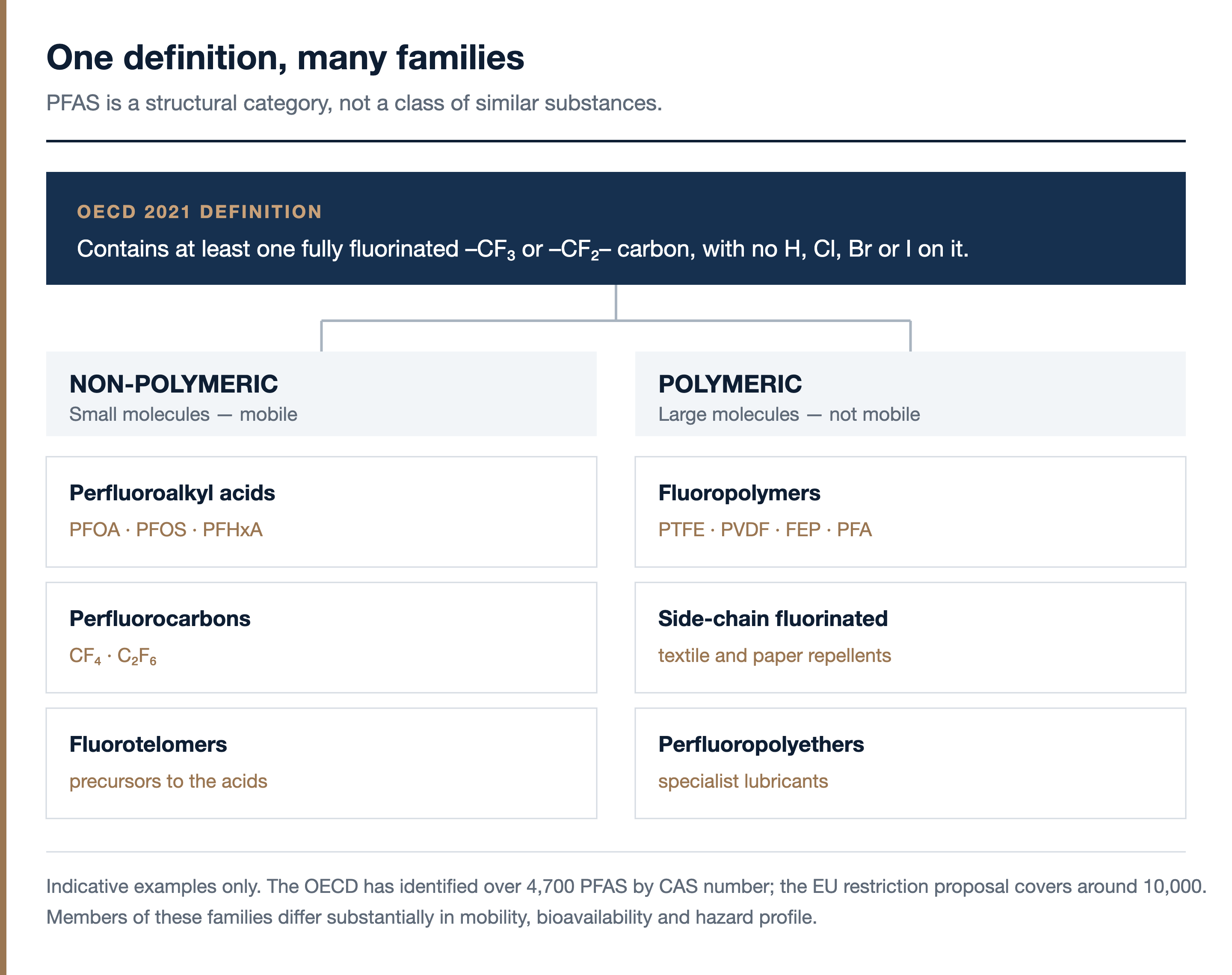
The families behave differently
The first division is between polymers and non-polymers, and it is the most consequential.
Non-polymeric PFAS are small molecules. This group includes the perfluoroalkyl acids (PFOA, PFOS and their shorter-chain successors), which are the substances behind most documented contamination. It also includes perfluorocarbons such as CF₄ and C₂F₆, and fluorotelomers, which can degrade into perfluoroalkyl acids.
Polymeric PFAS are large molecules. Fluoropolymers such as PTFE, PVDF, FEP and PFA are solids of high molecular weight, essentially insoluble and not biologically available in the way small molecules are. Side-chain fluorinated polymers (the durable repellents applied to textiles and papers) sit in a different position again, because their fluorinated side chains can degrade and release smaller PFAS.
Where the scientific disagreement sits
Critics of group regulation argue that PFAS is not a class of similar compounds but a range of substances with very different physical, chemical, environmental and biological properties, most of which have not been toxicologically characterised, and that fluoropolymers in particular do not exhibit the properties associated with the PFAS of concern. Regulators counter that assessing thousands of substances individually would take decades, and that substituting one PFAS for another has repeatedly reproduced the same problem. Both positions are coherent. The disagreement is about how to act under uncertainty, not about the chemistry.
Where they are used, and why
The pattern across applications is consistent. PFAS appear where a surface must resist something aggressive, or where a material must survive conditions that would destroy the alternatives.
| Application | Property being bought |
|---|---|
| Non-stick cookware (PTFE) | Nothing adheres to a surface of that low energy, and it tolerates cooking temperatures |
| Packaging | Grease and oil resistance at very low coat weight |
| Textiles and outerwear | Water and oil repellency that survives repeated laundering |
| Firefighting foams | Ability to spread as a film across burning hydrocarbon fuel |
| Semiconductor manufacturing | Etching and cleaning chemistry; chemically resistant handling equipment |
| Batteries and fuel cells | Binders and membranes that survive the electrochemical environment |
| Seals, gaskets, wire insulation | Chemical and thermal resistance in service |
| Medical devices | Inertness, low friction, sterilisation resistance |
| Metal plating | Mist suppression in aggressive baths |
| Refrigerants and lubricants | Thermal stability and defined volatility |
The breadth is reflected in the restriction proposal itself, which addresses manufacturing, transport, electronics and semiconductors, energy, food contact materials and packaging, metal plating, consumer products, construction, lubricants, medical devices, ski wax and textiles, with printing, sealing, machinery and technical textiles among eight further sectors added in the 2025 update.
A case worth separating: aluminium
Not every PFAS in industry is added deliberately. Primary aluminium production illustrates a different mechanism entirely.
In the Hall–Héroult process, when the alumina content of the electrolytic bath falls below the level required for electrolysis, cell voltage rises sharply in an event known as an anode effect. Carbon from the anode then combines with fluorine from the dissociated cryolite bath, producing tetrafluoromethane (CF₄) and hexafluoroethane (C₂F₆). Both are perfluorocarbons, and both fall within the PFAS definition.
Their significance is primarily climatic rather than toxicological. CF₄ and C₂F₆ have atmospheric lifetimes of approximately 50,000 and 10,000 years and global warming potentials of roughly 7,380 and 12,400 over a hundred-year horizon. Metal smelting, principally aluminium, accounts for the majority of historic anthropogenic emissions of these two gases.
Why the distinction matters
Cookware and food packaging involve the intentional use of an added substance for a functional purpose. Aluminium smelting involves the unintentional formation of a PFAS from a fluoride-based process chemistry. Both fall inside the same definitional boundary, but they present entirely different problems: one is a question of substitution, the other of process control. Reporting that treats them as equivalent obscures more than it explains.
A note on secondary aluminium, since the two are often conflated. Recycling operations commonly use fluoride-bearing salt fluxes for melting and refining. That is a fluoride question rather than a PFAS one, and any claim that recycling generates PFAS should be traced to a specific source. The well-documented formation pathway is the anode effect in primary production.
The underlying tension
PFAS are used because they solve problems for which there is often no equally good alternative. They are a regulatory concern because of the same bond that makes them work.
Persistence is not a side effect of the function. It is the function, observed over a longer timescale. A coating that resists chemical attack in service is a coating that resists degradation in the environment. That is not a design failure; it is the design, and it is why substitution is genuinely difficult rather than simply resisted.
Understanding that is the starting point for any serious discussion of the restriction, of derogations, and of what alternatives can realistically deliver.
References
- ECHA, ECHA publishes PFAS restriction proposal (7 February 2023). echa.europa.eu
- Swedish Chemicals Agency (Kemikalieinspektionen), PFAS. kemi.se
- IPCC, Good Practice Guidance: PFC Emissions from Primary Aluminium Production. ipcc-nggip.iges.or.jp
- International Aluminium Institute, Perfluorocarbon (PFC) emissions. international-aluminium.org
- Substantial increase in perfluorocarbons CF₄ and C₂F₆ emissions in China. PNAS. pnas.org
- The EU’s PFAS ban: a case of policy over science. PMC
Related reading
This article reflects independent professional analysis and is provided for informational purposes. It does not constitute legal advice or an official position of any organisation, and takes no position on the merits of the proposed restriction. Substance counts vary with definition and database. The EU restriction proposal remains under assessment; readers should verify the current position before relying on it. Last reviewed July 2026.