
Most public debate about packaging begins with a simple assumption: there is too much of it.
That concern is justified. Unnecessary packaging consumes resources, creates litter and undermines public confidence in the packaging industry. But in food, the fixation on excess can obscure a far more consequential failure. The worst packaging is however not necessarily the packaging that uses too much material. It is the packaging that fails to perform its primary function: protecting the product.
Almost all of a food product’s environmental impact lies in the food itself, not in the material surrounding it. When packaging fails and food is discarded, the loss is not limited to a carton, pouch or film. It includes the land, water, energy, labour, processing and transportation required to produce that food.
Measured across the full value chain, under-packaging can cost far more than over-packaging.
The footprint is in the food, not the wrapper
Food production is responsible for roughly a quarter of global greenhouse-gas emissions (Poore & Nemecek, Science, 2018; Our World in Data). And within any given food, the emissions sit overwhelmingly upstream: for most products, the farm stage and land-use change account for more than 80% of the footprint. Everything after the farm — processing, transport, retail and packaging — is a small remainder, with packaging typically only a few percent.
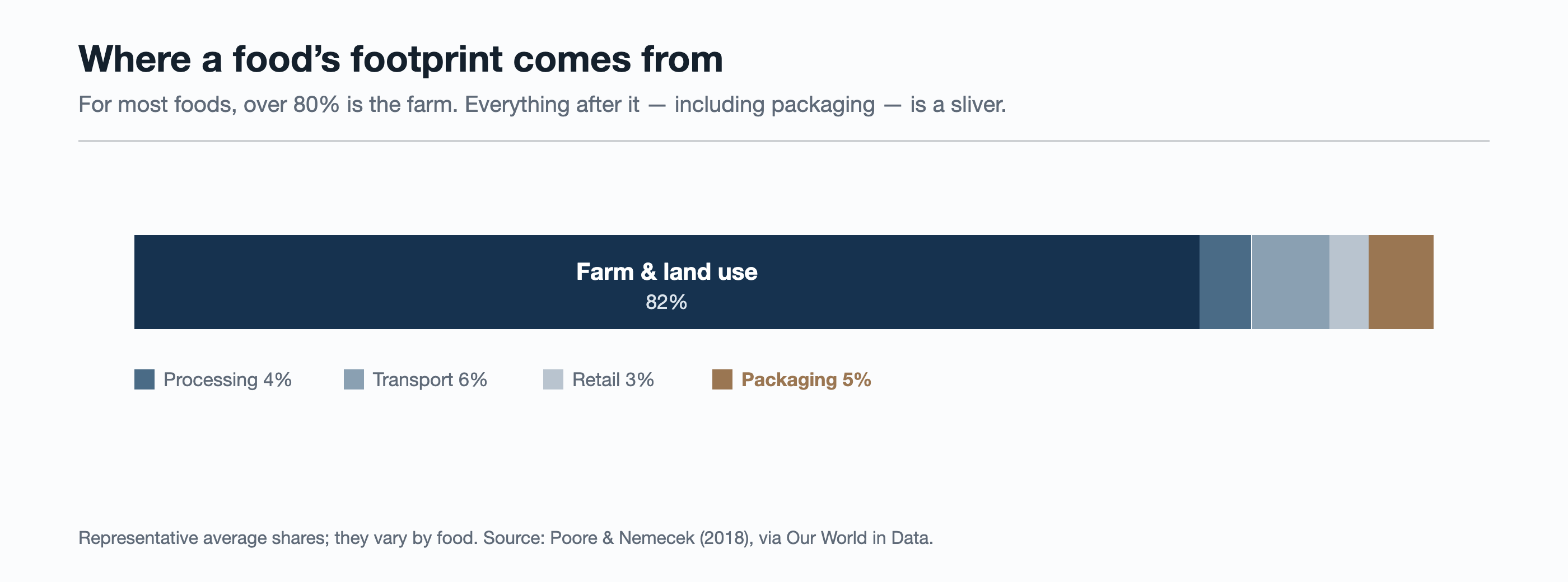
For most foods, over 80% of the footprint is the farm and land use. Packaging is one of the smallest slices.
That single fact reframes the debate. The environmental question is not, in the abstract, “how do we use less packaging?” It is “how do we make sure the food actually gets eaten?” because the food is where the impact lives.
The line that matters
Excess packaging wastes a wrapper. Packaging that fails to protect wastes the food, and everything it took to grow it.
We use the land to feed people, waste squanders all of it
Feeding the world already consumes about half of the planet’s habitable land and a large share of its freshwater. Having spent all that, throwing the food away is the least efficient outcome imaginable, and it is astonishingly common. Around a third of all food is lost or wasted: roughly 13% is lost between farm and shop, and another 19% is wasted at retail, in food service and in homes. In 2022, that came to about 1.05 billion tonnes.
The climate arithmetic is stark. Food loss and waste account for 8–10% of global greenhouse-gas emissions — nearly five times the emissions of aviation — and cost the world on the order of USD 1 trillion every year (UNEP and the FAO). Every wasted item drags its entire upstream footprint into the bin with it. Packaging’s core job is to stop that from happening.
Milk: the carton earns its keep
Take milk. A litre of cow’s milk carries roughly 3.2 kg of CO₂e, and behind it sits an outsized land and water demand — dairy uses on the order of 600 litres of water and several square metres of land per litre produced (Poore & Nemecek). That is a great deal of resource packed in one milk carton.
The liquid packaging carton that holds it is, by contrast, mostly renewable paperboard with a slim footprint. Its job is to keep light, oxygen and microbes out so the milk stays safe and drinkable. In aseptic form it does more, keeping the milk shelf-stable for months without refrigeration (see aseptic packaging). The packaging footprint is a small fraction of the milk it protects and if the pack fails, you do not lose the packaging, you lose the milk and its entire footprint. A carton that protects is one of the cheapest carbon savings in the whole chain.
Coffee: the ratio that should not be overlooked
Coffee sharpens the point. Roasted coffee is one of the highest-footprint foods by weight — published life-cycle assessments put conventionally grown, exported coffee at around 15 kg CO₂e per kilogram, with some estimates higher still. Its packaging, a small barrier pouch with a one-way degassing valve, is a rounding error beside it.
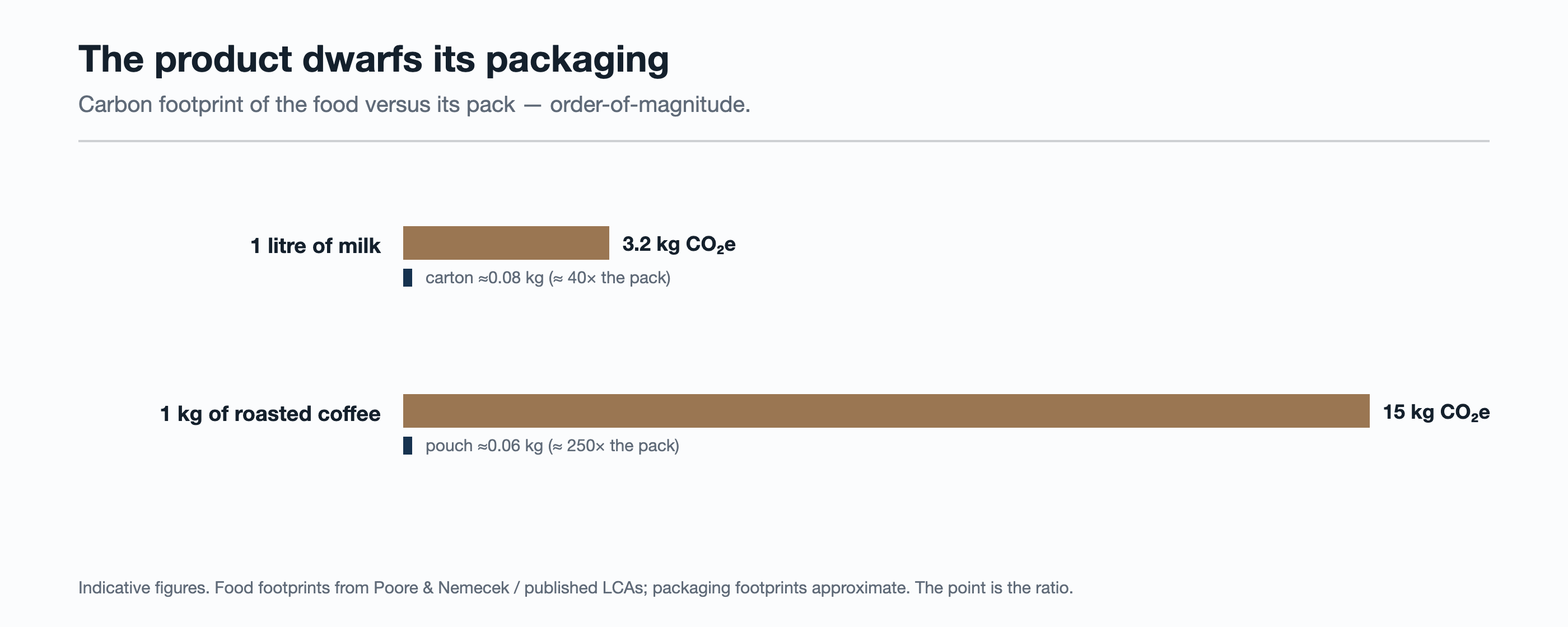
The food dwarfs its pack: milk by roughly forty times, roasted coffee by a couple of hundred. Packaging figures are indicative; the point is the ratio.
The product-to-packaging carbon ratio here runs into the hundreds to one. Skimping on that pouch to “cut packaging” is a false economy, where packaging fails to protect goods or sacrifices shelf-life: strip the barrier and the coffee goes stale or spoils, and a product carrying fifteen kilograms of CO₂e is wasted to save a pack carrying a few grams. The pouch is insurance policy.
Packaging that buys time buys savings
This is why shelf-life technologies matter environmentally. Aseptic cartons, high-barrier films and modified atmosphere packaging all do the same thing: they extend the window in which food is edible, which converts directly into less waste. The modest emissions embodied in a more capable pack are repaid many times over by the food it keeps out of the bin. The money follows the same logic, less spoilage means less written-off stock at every step of the chain.
This is not a licence for excess
None of this is an argument for using unnecessary packaging. Over-packaging remains a legitimate concern: it generates unnecessary waste, consumes materials without sufficient benefit and undermines public trust. The objective is not more packaging, but the right level of packaging, sufficient to protect the product throughout its journey, and no more than necessary.
This approach should be complemented by design for recycling. Ensuring that packaging is designed for recycling with underlying recycling systems, can be effectively collected, sorted and reprocessed can reduce their end-of-life impact without compromising product protection.
What the environmental calculation changes is the definition of “enough.” Packaging should be judged by its ability to protect the product, not by material reduction in isolation. Once a package is reduced beyond the point at which it can reliably preserve safety, quality and shelf life, it is no longer optimised; it is compromised. In the food sector, that failure can be the most environmentally and economically costly outcome of all.
In short
- Most of a food’s footprint is upstream; packaging is usually a few percent. The food is the thing worth protecting.
- Around a third of food is wasted, driving 8–10% of global emissions (about five times aviation) and some USD 1 trillion in losses each year.
- Milk (~3.2 kg CO₂e/L) and coffee (~15 kg CO₂e/kg) dwarf their packaging by roughly forty and a couple of hundred times.
- The right amount of packaging is set by protection, not minimisation. Under-packaging is the more expensive mistake.
References
- Poore, J. & Nemecek, T. (2018). Reducing food’s environmental impacts through producers and consumers. Science, 360(6392) — food ≈26% of global GHG; farm and land-use stages dominate, with packaging only a few percent.
- Ritchie, H. (2020). You want to reduce the carbon footprint of your food? Focus on what you eat, not whether it is local. Our World in Data — post-farm stages are a small share of most foods’ footprints.
- UNEP Food Waste Index and FAO; UNEP and the FAO (2024) — food loss and waste account for 8–10% of global greenhouse-gas emissions and cost about USD 1 trillion a year.
- Milk ≈3.2 kg CO₂e per litre (Poore & Nemecek); roasted coffee ≈15 kg CO₂e per kilogram (published life-cycle assessments).
Read further
- Aseptic packaging: the food is sterilised before it ever reaches the carton
- Modified atmosphere packaging: it is the gas, not the plastic, that keeps food fresh
- The mono-material myth: why “single material” does not mean “recyclable”
This article reflects independent professional analysis and is provided for informational purposes. Footprint and waste figures are drawn from the sources above and are representative; values vary by product, region and method. Last reviewed August 2026.