
From 19 July 2026, large companies may no longer destroy unsold apparel, clothing accessories or footwear placed on the EU market. The measure is short, specific and enforceable, and it marks a shift in what European product regulation is willing to prohibit outright rather than merely discourage.
Why: the case for intervention
Destroying an unsold garment discards a product that is already complete. Every input has been committed: fibre, water, energy, chemistry, labour and freight. Nothing is recovered, and the environmental cost has already been incurred.
The scale of the underlying system explains why the Commission considered this worth prohibiting. According to European Environment Agency data, producing the clothing, footwear and household textiles consumed by EU households in 2022 required 234 million tonnes of raw materials (around 523 kg per person), with two-thirds of those materials extracted or produced outside Europe.
The associated emissions are comparable in scale. Greenhouse gas emissions in the supply chain of textile products purchased by EU households in 2022 are estimated at 159 million tonnes of CO₂ equivalent, or 355 kg per person, making textiles the sixth largest climate impact among household consumption domains. Only 30 per cent of those emissions occur within Europe; the remaining 70 per cent are generated elsewhere, since nearly all production stages take place in lower-cost countries.
At end of life the picture is equally instructive. The EU generated approximately 6.94 million tonnes of textile waste in 2022, some 16 kg per person, a figure that has remained broadly stable since 2016. Of that, 11.1 kg per person was not separately collected (more than twice the 4.6 kg that was) and therefore entered mixed residual waste destined for landfill or incineration.
The efficiency trap
Between 2010 and 2022, greenhouse gas emissions per person from EU textile consumption fell by 22 per cent, while consumption rose by 15 per cent. Per-unit efficiency improved substantially; total impact did not fall correspondingly. This is the central reason regulators have moved from efficiency measures towards volume and flow controls. Making each garment better does not help if more garments are made and fewer are used.
One qualification is important, and it is one the regulation itself acknowledges. These figures describe textile consumption and waste as a whole, not the destruction of unsold stock specifically. Robust EU-wide data on the volume of unsold goods destroyed does not currently exist. That absence is precisely why the ban arrives paired with a disclosure obligation.
What: the measure itself
The instrument is the Ecodesign for Sustainable Products Regulation, Regulation (EU) 2024/1781, which entered into force in July 2024 and replaced the earlier Ecodesign Directive. The ESPR is framework legislation: it does not itself impose detailed product requirements, but empowers the Commission to introduce them progressively through delegated acts.
Three provisions matter here.
Article 23: prevention duty. All economic operators, regardless of size, must take measures that can reasonably be expected to prevent the need to destroy unsold consumer products. This applies to everyone, not only to the enterprises caught by the ban.
Article 24: disclosure. Companies must publish information on the annual volume of unsold consumer products discarded, the reasons, and the proportions sent to reuse, recycling or disposal.
Article 25: prohibition. The destruction of unsold consumer products listed in Annex VII is prohibited. Annex VII currently covers apparel and clothing accessories, whether knitted or crocheted or not, leather articles of apparel, and footwear.
Destruction is defined broadly: intentionally damaging a product, or discarding it as waste. The measure therefore captures shredding and disposal alike, not only incineration.
Who is caught, and when
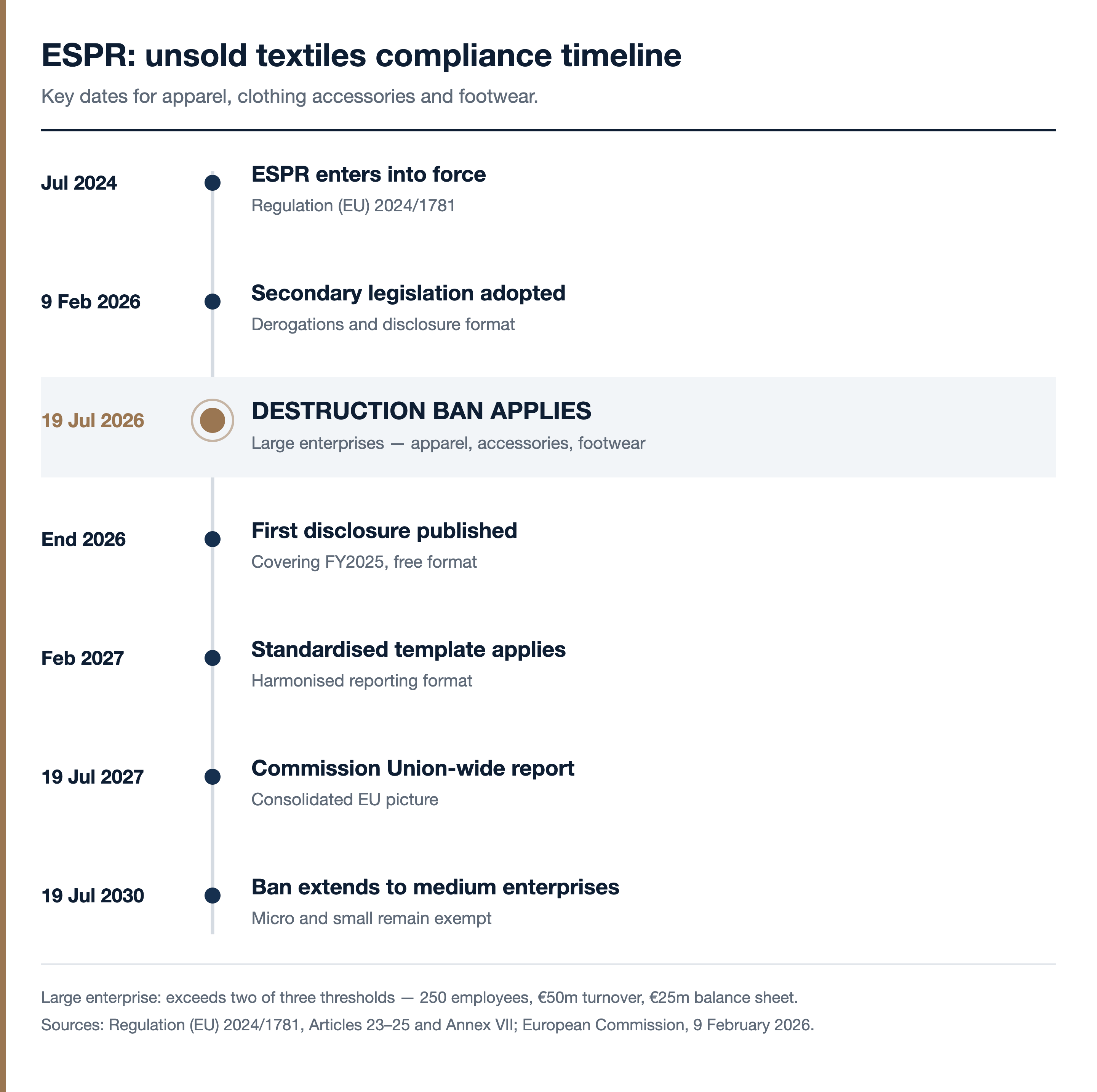
The ban applies to large enterprises from 19 July 2026 and to medium-sized enterprises from 19 July 2030. Micro and small enterprises are exempt from both the prohibition and the disclosure obligation.
An enterprise is large where it exceeds at least two of three thresholds under the Accounting Directive: more than 250 employees, more than €50 million turnover, or more than €25 million balance sheet total.
The exemption for smaller operators has attracted the obvious criticism: that unsold stock could be routed through smaller entities to escape the prohibition. The Regulation anticipates this, and permits the Commission to extend obligations to micro and small firms if evidence of circumvention emerges. Companies structuring around the threshold should assume the point is being watched.
Legal status
Regulation (EU) 2024/1781 is adopted and in force. On 9 February 2026 the Commission adopted the secondary legislation required to operate the regime: a delegated regulation specifying derogations from the prohibition, and an implementing regulation establishing the standardised disclosure format, product categorisation and verification framework. The obligations described here are therefore settled, not proposed.
How: what compliance requires
1. Determine status and scope. Establish whether the entity placing goods on the EU market meets the large-enterprise thresholds, and map the portfolio against the Annex VII codes. Group structures need particular attention: the obligation attaches to the entity, and corporate arrangements may place different parts of a portfolio in different positions.
2. Establish the data before it is demanded. Disclosure requires the number and weight of unsold products discarded, the reasons, and the destination split between reuse, recycling and disposal. Many organisations do not currently record this to the required granularity. The first disclosure covers financial year 2025 data, so the reporting period has already closed.
3. Build the derogation file. Destruction remains permissible in defined circumstances (safety risks, severe damage and other grounds set out in the delegated regulation) but must be documented and justified. A derogation without contemporaneous evidence is an enforcement exposure, and national authorities will oversee compliance.
4. Create the alternative routes. The Commission expects better stock and returns management, and alternatives such as resale, remanufacturing, donation and reuse. These channels take time to establish, require contractual arrangements, and carry brand-protection considerations that many companies have historically resolved by destroying goods instead. That option is closing.
5. Move the intervention upstream. The prevention duty in Article 23 points to the actual solution. Unsold stock is produced by forecasting, range architecture, order quantities and returns handling. Disposal is where the problem becomes visible, not where it is created.
The wider direction
This measure does not stand alone. Separate collection of textile waste became mandatory across the EU from 1 January 2025 under the Waste Framework Directive, addressing the same material from the other end of its life. Textiles and footwear were confirmed as priority product groups under the ESPR working plan, alongside parallel developments in packaging labelling under the PPWR, with product-level ecodesign requirements and the Digital Product Passport expected to follow through delegated acts.
The Commission is also empowered to extend the destruction prohibition to further product categories. Sectors outside textiles should read this as a template rather than an exception.
Assessment
The regulatory logic is coherent. A ban alone would be unenforceable without visibility, so disclosure accompanies it. A ban without exceptions would be unworkable for genuinely unsafe goods, so derogations are defined and documented. A ban applied immediately to every operator would be disproportionate, so it is phased by enterprise size.
The open question is volume. The prohibition governs what may be done with unsold stock; it does not directly limit how much unsold stock is created. Its effectiveness will depend on whether the cost and friction of compliant alternatives feed back into production and buying decisions, which is what Article 23 is intended to achieve, and what the disclosure data will eventually reveal.
For companies in scope, the practical position is straightforward. The deadline is fixed, the secondary legislation is adopted, and the first reporting period has already elapsed. The work that remains is data, documentation and alternative routes to market.
Sources
- Regulation (EU) 2024/1781 establishing a framework for the setting of ecodesign requirements for sustainable products (ESPR), in particular Articles 23, 24, 25 and Annex VII. EUR-Lex
- European Commission, New EU rules to stop the destruction of unsold clothes and shoes (9 February 2026). EU Circular Economy Platform
- European Environment Agency, Circularity of the EU textiles value chain in numbers. eea.europa.eu
- European Environment Agency, Greenhouse gas emissions from the EU’s textiles consumption. eea.europa.eu
- European Environment Agency, Textile waste generation per person in the EU per year. eea.europa.eu
- Directive 2013/34/EU on the annual financial statements of certain types of undertakings (enterprise size thresholds).
Related reading
This article reflects independent professional analysis and is provided for informational purposes. It does not constitute legal advice or an official position of any organisation. Detailed derogation grounds and reporting requirements are set out in the delegated and implementing regulations adopted on 9 February 2026; readers should work from those texts and take their own advice before relying on any interpretation here. Last reviewed July 2026.