
Hemicellulose forms films with genuinely excellent oxygen barrier properties. It is abundant, renewable, and already dissolved in pulp mill side-streams. It also fails as a barrier at the humidity a chilled supply chain routinely reaches, and for the same molecular reason that it works when dry.
Why hemicellulose is a good oxygen barrier
Hemicelluloses are branched polysaccharides (principally xylans in hardwood, glucomannans in softwood) and the second most abundant class of polysaccharide after cellulose. Structurally they carry a high number of hydroxyl groups.
Those hydroxyls hydrogen-bond extensively to one another. The resulting film is dense and cohesive, with very little free volume between chains, and oxygen molecules diffuse through polymers by moving through free volume. A tightly hydrogen-bonded polar network therefore presents an unusually difficult path.
The performance is real. Films based on hemicellulose, in particular pentosan-rich polysaccharides such as xylans, exhibit excellent oxygen barrier properties. Xylan–chitosan complex films at 50 per cent relative humidity showed oxygen permeability below 0.3 µm cm³/(day m² kPa), with stress at break of 10 MPa, figures in the range that food packaging requires.
The same feature is the failure mode
A hydroxyl group that hydrogen-bonds strongly to a neighbouring chain will hydrogen-bond just as readily to a water molecule. As humidity rises, water enters the film and inserts itself between the chains.
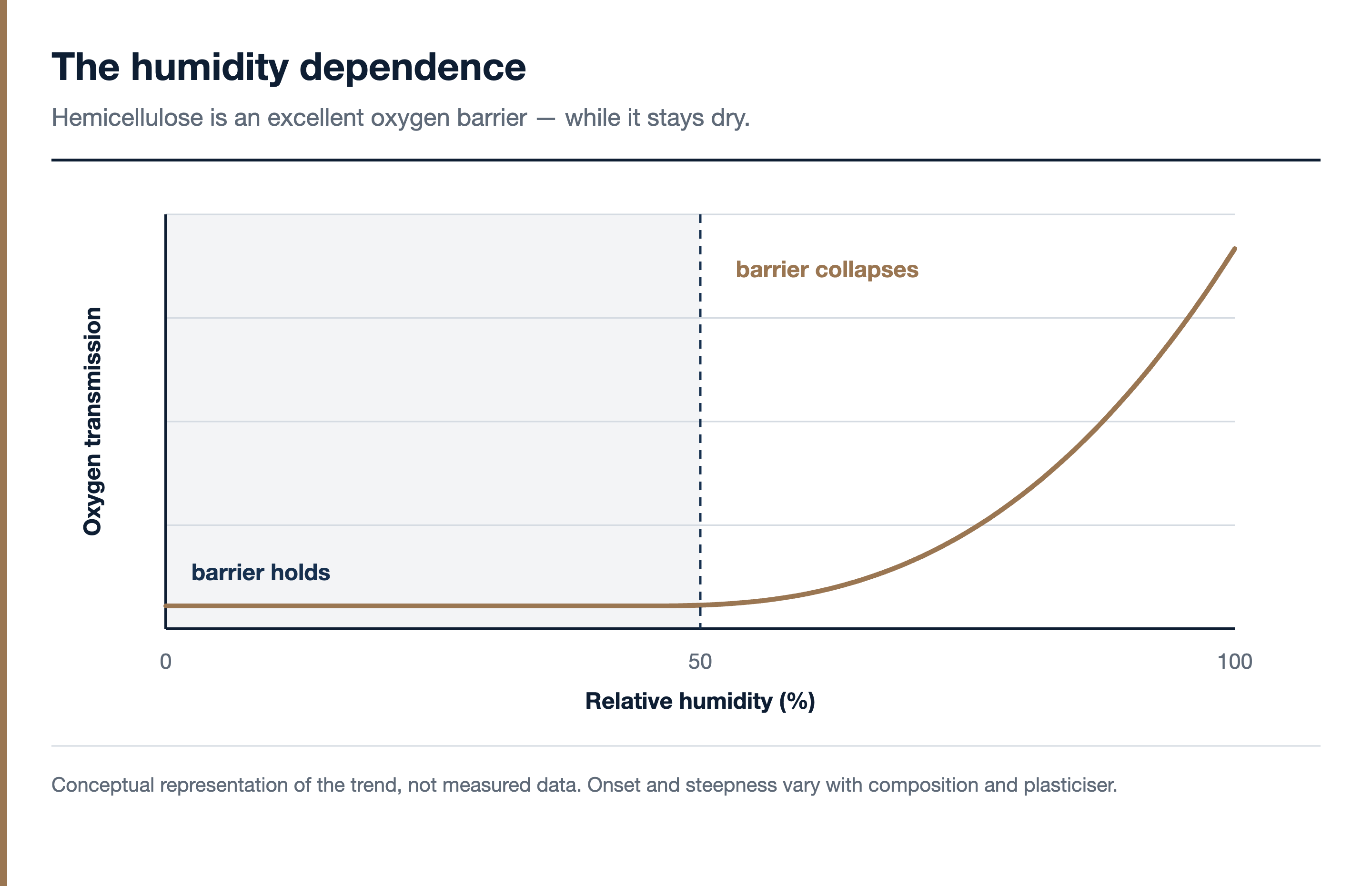
Two things then happen together. The polymer–polymer bonds that made the network dense are replaced by polymer–water bonds, and the absorbed water acts as a plasticiser, increasing chain mobility and free volume. The barrier does not degrade gradually; it collapses over a relatively narrow humidity range.
Why this is the whole problem
Barrier data reported at 50 per cent relative humidity is a laboratory condition, not a supply chain condition. A chilled cabinet, a humid warehouse or a product with high water activity puts the coating well beyond that point. This is why hemicellulose films are described as showing inferior barrier properties compared with fossil-derived films because of their strong hydrophilicity, and it is the single obstacle the field is working on.
Where latex comes in
Hemicellulose has two further practical weaknesses as a coating. It is brittle when dry, because a densely hydrogen-bonded film has little chain mobility. And it is applied from water onto paper, which absorbs the water and disrupts film formation.
Latex (typically a styrene-butadiene dispersion) addresses both. It is a proven film former in paper coating, supplies flexibility and adhesion, and gives a smooth, closed surface for a subsequent layer. In practice the arrangement is often sequential rather than blended: a latex pre-coat applied to the board, then a hemicellulose layer on top, with a plasticiser to manage brittleness.
Each layer does what it is good at. The latex supplies mechanical integrity, hydrophobicity and a suitable surface; the hemicellulose supplies the oxygen barrier, which latex alone cannot provide.
An important limitation
Latex improves film formation, flexibility and water resistance at the surface. It does not change the moisture sensitivity of the hemicellulose layer itself. Slowing the ingress of liquid water is not the same as preventing the uptake of water vapour, and it is vapour that plasticises the barrier. Latex solves the mechanical and application problems; the humidity problem remains a hemicellulose problem.
The approaches that address the barrier itself
Three strategies recur, and each attacks the hydroxyl group in a different way.
Crosslinking ties the chains together with covalent bonds that water cannot displace. Esterifying a xylan/PVOH film with butane tetracarboxylic acid produced a more compact crosslinked network with reduced spacing between chains, improving oxygen barrier, hydrophobicity and tensile strength together.
Chemical modification converts hydroxyls into less polar groups through esterification, etherification or coupling, reducing water affinity at the cost of some barrier performance, since the same polarity underlies both.
Reinforcement disperses crystalline nanoparticles, typically cellulose nanocrystals, through the film. These are impermeable, lengthening the diffusion path, and can interact with the matrix through hydrogen bonding to restrict swelling.
The unifying observation is that all three reduce the availability of free hydroxyl groups to water. That is the design variable.
Why it is worth the effort
Oxygen barrier is the property most often achieved in fibre-based packaging by laminating a polymer film or metallising a layer, and it is precisely those constructions where innovation is needed to transition to renewable structures. A thin, water-applied, fibre-compatible coating that delivers oxygen barrier is therefore valuable out of proportion to its thickness.
The feedstock argument is also strong. Hemicellulose is dissolved during pulping and largely lost to the recovery boiler. Recovering it as a coating polymer converts a combustion stream into a material stream, on the same site.
Notably, hemicelluloses have received comparatively less attention than cellulose and lignin in this context, which is surprising, given that oxygen barrier is one of the few functional properties at which they are naturally excellent.
References
- Hemicellulose-based latex coatings for oil and hydrocarbon barriers in fibre packaging. ScienceDirect
- Films from xylan/chitosan complexes: preparation and characterization. Cellulose. Springer
- Enhancing hydrophobicity and oxygen barrier of xylan/PVOH composite film by 1,2,3,4-butane tetracarboxylic acid crosslinking. Polymers 15(13), 2811. MDPI
- Xylan hemicellulose: a renewable material with potential properties for food packaging applications. Sustainability 13(24), 13504.
- Hansen, N. M. L. & Plackett, D. (2008). Sustainable films and coatings from hemicelluloses: a review. Biomacromolecules 9(6), 1493–1505.
- Gröndahl, M., Eriksson, L. & Gatenholm, P. (2004). Material properties of plasticized hardwood xylans for potential application as oxygen barrier films. Biomacromolecules 5, 1528–1535.
Related reading
This article reflects independent professional analysis and is provided for informational purposes. Barrier values are specific to the formulations, thicknesses and test conditions of the cited studies and are strongly dependent on relative humidity. Last reviewed July 2026.