
The PPWR defines composite packaging for the first time at EU level. The definition is administratively useful and conceptually modest: it sorts packaging into categories so that obligations can be assigned. It is not a scientific description, and it says nothing about whether a packaging is recyclable or environmentally preferable. Reading it as though it did is a common and consequential error.
The definition
Under Article 3 of Regulation (EU) 2025/40, composite packaging means a unit of packaging made of two or more different materials, which are part of the weight of the main packaging material and cannot be separated manually and therefore form a single integral unit, unless a given material constitutes an insignificant part of the packaging unit and in no case more than 5 per cent of the total mass of the packaging unit, and excluding labels, varnishes, paints, inks, adhesives and lacquers. The definition applies without prejudice to the Single-Use Plastics Directive.
That is a single sentence carrying four separate tests. Taken in order:
- Two or more different materials. Material means a material category (paper, plastic, metal, glass, wood), not an individual grade or polymer.
- Not manually separable. If a consumer can pull the components apart by hand, they are not constituting a single integral unit, thus not accounted in composite assessment.
- The de minimis test. A material that is an insignificant part of the unit, and in no case more than 5 per cent of total mass, is disregarded. Note that this is a two-part test: insignificance and the 5 per cent ceiling.
- The exclusions. Labels, varnishes, paints, inks, adhesives and lacquers are excluded outright, regardless of mass.
Why a definition was needed
Directive 94/62/EC provided only a qualitative definition of composite packaging and did not establish a harmonised EU-wide interpretation. As a result, Member States developed their own definitions through national implementing legislation and the rules of extended producer responsibility schemes.
The consequences were practical rather than theoretical. The same carton could be reported as paper in one market and as composite in another. EPR fee categories differed, and so did the fees. National reporting on packaging waste by material was built on inconsistent classifications, which limited what could be concluded from the aggregate data. A producer selling one product across the Union had to maintain several parallel classifications of an identical packaging.
Because the PPWR is a Regulation rather than a Directive, the definition applies directly in all Member States without national transposition. That is the substantive gain: not that the boundary is drawn in the ideal place, but that it is drawn in the same place everywhere.
Worked examples
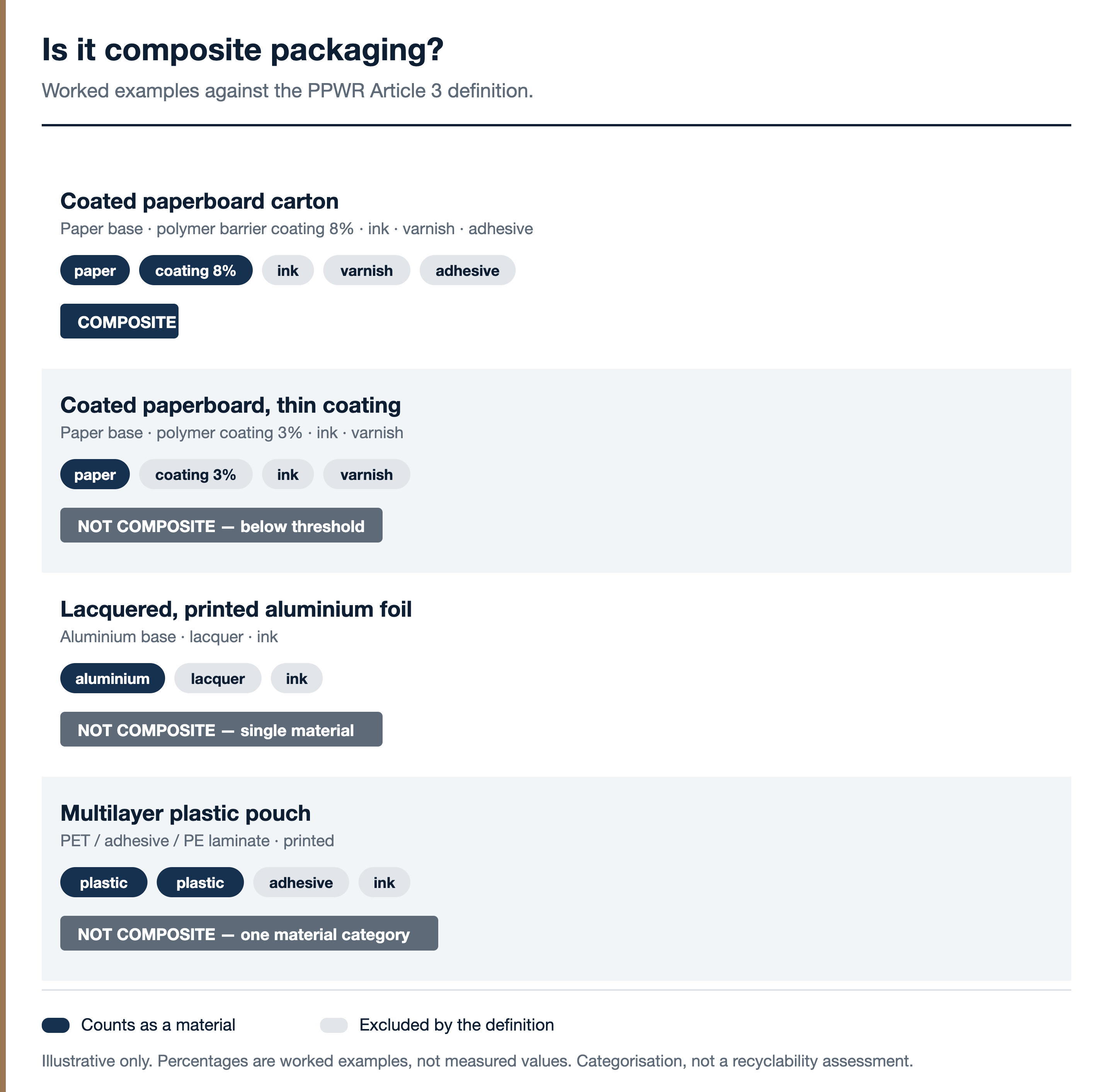
1. Coated paperboard carton with ink, varnish and adhesive
Take a folding carton: paperboard base, a polymer barrier coating, printing ink, an overprint varnish, and a glue seam.
Work through the tests. The ink, varnish and adhesive are excluded outright: they are named in the definition and drop out of the assessment. That leaves paperboard and the polymer coating: two different material categories, which cannot be separated by hand.
The outcome now turns entirely on the coating’s mass. If it is insignificant and no more than 5 per cent of the unit, the packaging is not composite and is classified as paper. If it exceeds that, the packaging is composite (composite packaging of which the majority is paper/cardboard).
Two things follow that are worth stating plainly. A meaningful physical difference (a barrier coating that genuinely affects repulping) may fall either side of the line on mass alone, a coated board may also offer higher yield in recycling than certain mono-material paper/cardboard, should it be designed for recycling, underlining that amount alone is not a decisive factor but important categorical differentiator. And the ink and varnish, which can influence sorting in practice, play no part in the composite packaging classification.
2. Lacquered and printed aluminium foil
An aluminium foil lid: aluminium substrate, a protective lacquer, printing ink.
The lacquer and ink are both named exclusions. Removing them leaves aluminium alone: one material. The first test is not met, so the packaging is not composite. It is classified as metal.
This holds even though the lacquer is a genuine organic coating, chemically distinct from aluminium, makes up significant mass share of the foil and even though it burns off in the remelt. The definition keeps that lacquers are not part of the classification question.
3. Printed, adhesive-laminated multilayer plastic pouch
This is the example that most often surprises people. A pouch built from a PET outer layer, a laminating adhesive, and a PE sealant layer, printed between the layers.
The adhesive and ink are excluded. That leaves PET and PE, which are different polymers, but the same material category. The packaging is made of plastic. It therefore fails the “two or more different materials” test, and is not composite packaging. It is plastic packaging.
The point this makes
A multilayer PET/PE laminate is among the more difficult formats to recycle mechanically, because the polymers are incompatible in the melt and cannot easily be separated. Yet it is not composite. Meanwhile a paperboard carton with a 6 per cent coating is composite. If the classification tracked recyclability, these results would be reversed. It does not, because that is not what it is for.
What the definition is, and what it is not
It is a legal classification rule. Its function is to determine which material category a packaging unit belongs to, so that obligations can be attached to it consistently: reporting by material stream, extended producer responsibility categories and fees, recycled content calculations among others.
It is emphatically not a scientific description of the packaging. It disregards inks, varnishes, lacquers and adhesives, does not consider effects on sorting and reprocessing. It resolves a categorical question (how to group and classify packaging) with a mass threshold.
It is not a recyclability or sustainability statement. Recyclability is addressed separately under the Regulation, through design-for-recycling criteria and performance grades to be established for 22 packaging categories by delegated act, with classifications from A downwards according to assessed recyclability. Those provisions do the environmental work. The composite definition does none of it.
The claim to avoid
“Our packaging is not composite under the PPWR” is a statement about legal classification. It is not evidence that a packaging is recyclable, that it will be accepted in a waste stream, or that it performs better environmentally than an alternative. Presented as though it were, it is an unsupported claim, and one that a competent authority or a technically literate customer will identify quickly.
Why a pragmatic boundary is nonetheless the right approach
It would be easy to read the preceding section as criticism. It is not.
A classification rule must be applied consistently by thousands of operators and enforced by authorities across twenty-seven Member States. It has to be determinable from a specification sheet, stable over time, and reproducible between two people assessing the same packaging. A rule that required a recyclability assessment before a packaging could be classified would collapse under its own weight, and would make classification dependent on infrastructure that varies by country.
The mass threshold is arbitrary in the sense that any threshold in this regard is arbitrary. It is also unambiguous, cheap to verify, and difficult to argue about, which are the properties a classification rule actually needs.
The Regulation is coherent on this point: classification is handled by definition, and environmental performance is handled by the recyclability provisions. Problems arise only when the first is presented as though it answered the second.
Practical implications
Know the mass fractions. For packaging, the coating weight relative to total unit mass now determines the material classification. That figure should be documented, not estimated.
Do not assume national practice carries over. Where a packaging was previously classified differently in different markets, one of those classifications is now wrong.
Keep classification and recyclability separate in your documentation and your claims. They answer different questions, are established by different provisions, and can point in opposite directions for the same packaging.
Watch the interaction with other instruments. The definition applies without prejudice to the Single-Use Plastics Directive, and separate rules govern the plastic component of a packaging for recycled content purposes. A packaging that is not composite under the PPWR may still be caught by obligations addressed to its plastic content.
References
- Regulation (EU) 2025/40 of the European Parliament and of the Council of 19 December 2024 on packaging and packaging waste, repealing Directive 94/62/EC, in particular Article 3 and Annex II. EUR-Lex
- European Parliament and Council Directive 94/62/EC on packaging and packaging waste. EUR-Lex
- Directive (EU) 2019/904 on the reduction of the impact of certain plastic products on the environment. EUR-Lex
- PPWR Guidebook, Glossary. ppwr-guidebook.eu
Related reading
This article reflects independent professional analysis and is provided for informational purposes. It does not constitute legal advice or an official position of any organisation. Worked examples are illustrative and simplified; classification of a specific packaging unit depends on its actual composition and mass fractions. Readers should work from the text of Regulation (EU) 2025/40 and take their own advice. Last reviewed July 2026.